Posted by: T. Boyd | April 23, 2009

Heavenly Clocks

My Dad's pocket watch - most accurate for its time

He reveals deep and hidden things; He knows what is in the darkness,and the light dwells with Him. (Daniel 2:22 ESV)

There are some really interesting stories about the stars and clocks. Two tales come to mind. One is Galileo and the first study he made of Jupiter. And then a century or two later, the story of the British watchmaker, John Harrison.

Galileo took his first successful telescope and turned it on the planet Jupiter on Jan. 7, 1610. He recorded the sight in his notebook, making a sketch of the planet which had become larger than a pinpoint of light in the eyepiece. But he also noticed three stars near the view of the planet that happened to be in a straight line, with that line passing through the center of Jupiter.

The second night he looked again, and something seemed wrong. He faithfully sketched this new view, comparing it with the first one, and the stars were not in the same arrangement that they had been the first night, although they still were in a straight line. Had he made a mistake the first night?

He could not wait until the 3rd night, but alas! It was raining that night. Later in the week, he was able to look again at Jupiter and these strange stars and see that the arrangement was indeed different from either of the other two sketches. What was going on?

It took him several days finally to catch on. These points of light were not stars, but four moons of Jupiter orbiting quite close to the planet, with the moon (now called Io) nearest Jupiter, making a complete circle around the host planet in a mere 42 hours. Note: frequently you can only see 2 or 3 of them, because one or more of them are behind or in front of the planet, which is why it took several days to see all four.

What was really significant about this, and it got him in trouble with the church hierarchy, was that here was a clear example of something in orbit around a body other than the earth. Much debate was going on at that time because many believed that the whole universe revolved around the earth, including the sun. But Galileo was able to agree with Copernicus that the earth is not at the center of everything, and here was proof in the Jovian system. (Jove = Jupiter).

The second story is about the first clock made accurately enough to carry on a ship and yield accurate navigation data on a round trip voyage from England to the New World. I will write about that story soon.

And how did they check the clock for accuracy? By the moons of Jupiter! This was in 1714, and by then tables for the times of the motions of these 4 moons of Jupiter were published for navigation, with accurate predictions of these motions for several months into the future.

So, once again, here is a beautiful example of the Designer of the universe giving us a hidden source of knowledge – a mystery – that has been revealed to mankind. In fact the Greek word translated as mystery in the Bible means something hidden that has been uncovered. Isn’t our Lord wonderful!
Posted by: T. Boyd | April 15, 2009

Walking under the Stars

Arc to Arcturus

Arc to Arcturus

And they said one to another, Did not our heart burn within us, while he talked with us by the way, and while he opened to us the scriptures?” And they rose up the same hour, and returned to Jerusalem… (Luke 24:32-33 KJV)

Easter Sunday evening,  I decided to see how it would be to walk at dark like the 2 disciples did on the road from Emmaus back to Jerusalem, 3 days after Passover, as related in the Luke passage.  This year we had about the same Passover to Sunday arrangement of days that they had at the time of the Resurrection of our Lord Jesus.

At dusk I started walking into the 40 acres of woods behind our house along an old path that I frequent, trying not to use the flashlight in my pocket.  This was not exactly the same thing the disciples experienced, since there are few trees in that part of Israel and I think their road was easier to see than this narrow path through the tall trees.

Soon I was struggling to see the path at all, but I looked up, and the brighter stars had burst forth, soon to be followed by a myriad of others.  I was comforted that I could use the stars to help navigate as I deviated from my customary path to go over to the edge of a large beaver pond I had discovered a few days ago.  I picked out a bright star in the South to get my orientation so I could retrace my steps, keeping it to my right, thus walking in a easterly direction.  The woods and brush are thick there, but I made it to the edge of the water and enjoyed hearing the frogs croaking and some other night sounds.

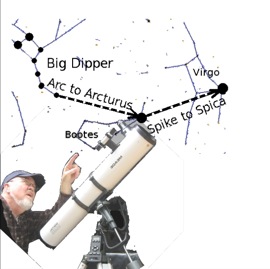
By this time I could tell the bright star I had picked out was Sirius, also called the “dog star”, in the constellation Canis Major (“the big dog”).  I also found the stars Arcturus and Spica.  I recalled with amusement the Intro. to Astronomy course I taught circa 1975 at Piedmont College in Georgia.  That summer night class consisted of two  rather unenthusiastic guys who, I believe, took away only one thing from the class: “Arc over to Arcturus and spike over to Spica.”

And that little mnemonic is exactly what I used Sunday night to identify these stars when I got to a part of the journey where I could see enough of the sky to use the trick.  The picture above has a diagram of the Big Dipper, Bootes, and Virgo.  You take the Big Dipper’s handle and imagine an arc extending from the handle over to a bright reddish star, which is Arcturus in Bootes.  And then you continue the arc,  “spiking” over to Spica (which rhymes with “spike a “).  To see Sirius,  you keep turning toward the western part of the sky and notice it as the current very bright “evening” star at about the same altitude above the horizon as Spica.

Maybe this will help some of you to get started in finding your way in the night sky.  It is very satisfying to take up this hobby and be able to name the constellations and the bright stars you have seen all of your life.  Also, as you become familiar with them,  it is easy to pick out the planets because they travel slowly through the constellations,  “messing up” the patterns you have gotten used to.  For example,  Saturn is in Leo this year,  clearly causing the “Lion” to look different.

By the way,  my usual one hour walk took almost two hours in the dark.  I did use the flashlight a few times, but did pretty well getting back to my home in the dark.  It gave a new perspective on the 2 mile or so path,  a quiet and beautiful memory in my heart.

Posted by: T. Boyd | April 6, 2009

Flames of Fire

The voice of the Lord is powerful;elect_static_mtr
The voice of the Lord is full of majesty…
The voice of the Lord flashes forth flames of fire.
The voice of the Lord shakes the wilderness;

(Ps. 29:4-8 ESV)

We have all heard the story of Benjamin Franklin sending up a kite during a thunder storm and being shocked through a key tied to the kite string. But I was surprised years ago to find out that this electricity is available on clear, cloudless days as well. Which brings to mind another story from our family chronicles.

Back in the 80’s (last century, to you youngsters), our middle school-age son decided for his science project to investigate this atmospheric electricity by making a static electricity motor.

He worked hard for weeks on the contraption, the design gotten from Scientific American, I believe. It consisted of a circular piece of plastic about 10 inches in diameter, balanced very carefully on a tiny ball-bearing axis.

We gathered the gang – our 2 sons, my wife, and myself – in the front yard and launched a red weather balloon. It was about 4 feet in diameter and full of helium. The tether was made of fishing line, with small copper wire tied along side, plus a static electricity collector made up of narrow strips of metal screen right under the balloon.

We reeled out about 200 or 300 feet of the line and wire, with the plan to connect the wire to the electric motor when we got it up. We tried connecting it at several heights, with nothing happening, when suddenly, our younger son, cried out, “Ouch! Mom, you shocked me!”

I shouted, “Ya hoo – it’s working!” and about that time our older son yelled, “It’s turning!” And we watched as the wheel gradually turned faster and faster while he took notes on the experiment.

How much power is available from this source? The numbers are quite impressive on one scale (volts) but very weak on the other (amps). The voltage goes up about 100 volts (more in winter) every yard in altitude (100 yards = 10,000 volts), but the current is in the microampere range – enough to turn a very delicate motor, but not enough to power anything useful from the motor.

There are different theories about where the electricity comes from. The one that makes sense to me is that it is from the friction of air molecules upon each other as they move with the wind. There is an article on Wikipedia about atmospheric electricity
which may be of interest.

This source of energy is responsible for the amazing display of flashes of lightning that come in thunder storms, another wonderful example of the intricacies of the creation of our God.

Give thanks to the Lord of lords…
To Him who alone does great wonders…
To Him who by understanding made the heavens,
for His steadfast love endures forever;

(Ps. 136:3-5 ESV)

Posted by: T. Boyd | April 2, 2009

The Dance of the Planets

Jupiter, Venus, and the Moon over Oahus Koolau mountains.

Jupiter, Venus, and the Moon over Oahu's Ko'olau mountains.

Let the sea roar, and all that fills it;
the world and those who dwell in it!
Let the rivers clap their hands;
Let the hills sing for joy together…
(Ps. 98:7-8 ESV)

Our solar system moves with wondrous complexity. All of the planets revolve around the Sun at different rates, all of the bodies rotate on their axes, the moons revolve around their respective planets. Some call this motion the dance of the planets.

But what is in our solar system? The sun (named Sol), of course, the 8 or 9 planets (depending on what you call Pluto), the many moons of the planets, the asteroids, the meteoroids, the periodic comets, an abundance of debris and dust – mostly natural, but some man-made – all of these are captivated by Sol’s gravitational pull.

An aside: my granddaughter’s third grade class voted to reinstate Pluto to the planet status. Pluto’s demotion to a dwarf planet due to its small size ( done by an international committee of astronomers) apparently has not gone down well with some members of the elementary school set. I think I agree, even though, I have never been able to find it in the sky. I will have to get back into that endeavor … maybe after getting my garden started for the spring.

Here is an amazing fact: with only a very few exceptions, the orbital motions – the revolutions of the planets and moons around their “parents”, and the rotations of these bodies on their axes – are all in a counter-clockwise direction as seen from the north star. In other words, if you could fly out to Polaris (our north star) and look “down” on the solar system, you would see practically all of the rotational motion moving in the same counter-clockwise direction, rather like a ballroom full of dancers all twirling in the same direction.

This orderly motion makes it possible to predict where everything will be in the future unless some outside object intrudes into the system. What are some of the easier predictions?

The most obvious motion is the daily rotation of the earth on its axis, which makes the sun and moon move across the sky from east to west, but likewise the stars and planets move at about the same rate across our sky, also from east to west. But because we are also traveling around the sun once per year, the stars and planets rise (and set) about 4 minutes earlier each day. It is this motion that causes different stars to appear overhead at different times in the year.

At the same time, the moon is revolving around the earth at a rate of about 28 days, so that it rises and sets about an hour later each day. An intricate addition to this orbital dance is the motion of the planets, each of which gradually moves among the stars westerly across our sky. It takes, for example, Jupiter about 12 years to orbit the sun, and since there are 12 constellations around the sky’s equator, it moves about one constellation per year in its orbit.

At present Jupiter is in the constellation Capricorn. Next year at this time, it should be in the constellation Aquarius (I am having a difficult time confirming this away from home at this time, because most of the internet sources talk about astrology instead of astronomy – we need another article to talk about that!)

Anyway, all of this makes it exciting to look up after the weeks of cloudiness and rain with which we have been blessed in central Virginia and see an unexpected bright light among the “fixed” stars, and wonder what it is. Is it Jupiter or Mars or Saturn, or maybe something else?

This article supposed to appear in the Caroline Progress on April 2, 2009, and will be copyrighted by the newspaper.

Posted by: T. Boyd | March 25, 2009

What kind of fuel is burning in stars?

Astrophysicists think the energy that fuels the huge output of heat and light from a star is nuclear fusion. All of the measurements of the radiation from stars is consistent with fusion. But what is nuclear fusion? And for comparison, what is nuclear fission?

Both of the processes involve producing final products that are more stable than the initial ingredients. Fission happens when a heavy nucleus breaks up into two or more lighter nuclei, releasing lots of energy, because the lighter nuclei are more stable. Fusion goes the other way. Two very light nuclei are combined to give a heavier, more stable nucleus, releasing even more energy per gram, because the difference in stability between the “parents” and the “child” is even greater.

The most stable nuclei have 50-60 neutrons plus protons in them (iron and nickle, are typical in this range). So the final product at the end of the life of a star, for example, is a large chunk of this material. The lighter elements (nuclei) have fused together into these medium-heavy nuclei.

For comparison, nuclear fission starts with very heavy nuclei, Uranium, for example, with 238 neutrons and protons, and splits up into products frequently in this same range of medium-heavy nuclei.

So, to review, a star spends something like 99% of its life converting Hydrogen into Helium in the fusion process, then it changes character, spending the rest of its life (much shorter time scale) combining Helium into heavier nuclei, and those products into heavier ones still, until the stability maximum is reached, then it “dies”.

Since fusion is more efficient than fission, then why haven’t fusion reactors been made successfully for man’s use? The answer is, because it is very difficult to get the Hydrogen nuclei close enough to combine. They naturally repel each other because the protons are positively charged (remember, like charges repel).

Because a star is so massive, the strong gravitational force overcomes the repulsion between like charges, forcing them close enough to fuse. This kind of force has been very difficult to produce in the laboratories on earth. Only in the Hydrogen bomb has fusion been consistently possible. The atomic bomb is a fission process.

So that is a brief account of how a star “burns”. Another article will talk about the sequence of the life of a star including the time scale involved.

Posted by: T. Boyd | March 22, 2009

Double Stars

“Who alone stretched out the heavens
and trampled the waves of the sea;
Who made the Bear and Orion,
the Pleiades and the chambers of the south?”
(Job 9:8-9)

Double Star in Cygnus: Albereo (Beta Cygni)

Double Star in Cygnus: Albereo (Beta Cygni)

Conversation with wife, written in the style of the classics:

Husband:  Have I told you lately … (wife waits eagerly for the rest of sentence) …  that about 1/3 of all the stars are double stars?
Wife:  (a little disappointed, sighs) I remember your telling me that years ago when you taught at Randolph-Macon.  Is that when 2 stars revolve around each other?
H:  That’s right.  But most of the stars are so far away that you can’t see two separate stars, even with the most powerful telescopes.  By the way, I looked at some (relatively) close-by ones last night – some are very beautiful, made up of two distinct colors.
W:  How do they know that the far away ones are made up of two stars?
H:  Good question.  There are several techniques to discover that.  One is when one star goes in front of the other and the light gets dimmer – those are called eclipsing binary stars.
W:  I see.  What’s another way?
H:  Well, when a star is moving away from us or toward us, the color (spectrum) of the star changes slightly.   When receding it gets more red, and when approaching, it gets more blue.  As they go around each other, one star in a double star will usually be moving away from us and its partner toward us.
W:  Is that called “red shift”?
H:  Yes, red and blue shift.  So in a double star, we see two distinct spectra.  I’m not explaining it very well, but that is the gist of it.   The complete story is much longer.
W:  Yes, that’s enough.  Well, what keeps the stars away from each other?  What happens if one falls into the other?  And if our Sun had a twin star, how far away would it be?
H:  Whoa… too many questions.  Actually, the Sun has a little sister, an “almost-star”: the planet Jupiter.  That was the point of the sequel to the movie 2001, whatever the second movie was called.  At the end of the story, Jupiter finally ignited and became a second star in the solar system.  Our Lord, who formed the solar system, fine tuned it so life is possible.
W:  But, what would happen to us if that did happen?
H:  You mean, if Jupiter became a star?  I think we would soon die because the life sustaining balance of the Earth would be too drastically changed with the extra radiation and with its coming from two different sources.
W:  Hmm … That sounds like a plot for another movie.
H:  Right.  Now back to your other questions.  The thing that keeps binary stars apart is the same thing that keeps Jupiter from the Sun – just regular orbital motion explained by Newton’s laws of motion.   The inward pull of gravity is offset by the tendency to go flying off in a straight line.  This tendency is called inertia, and wrongly labeled as a force as in centrifugal “force”.
W:  (Yawns). This is getting a little long, but one more question.  What happens if one star falls into another?
H:  A lot of different things could happen depending on the what was left after the collision and explosion.    But I expect that before that happened,  the stars would “die” (run out of hydrogen, then the heavier elements, in the fusion process) before the stars would get close enough to merge.
W: (Eyes getting glazed over). Sometime you can tell me about the life of a star.
H:  O.K.  Now… have I told you lately …. that I love you?
W:  Ah, that’s what I really wanted to hear….

Afterword by my wife: The odd thing is that we really did have the above conversation – which goes to show, I think, that if you can follow a man’s conversation down the roads of fishing lures, gadgets, and other assorted interests, he will eventually say something worth waiting for.

Note: This article copyrighted by Caroline Progress 2009

Posted by: T. Boyd | March 16, 2009

Micrometeorites in the Snow (part II)

(Photo on Steve Spangler's blog)

(This article submitted to Caroline Progress)
“For as the rain and the snow come down from heaven
and do not return there but water the earth, so shall my word be that goes out from my mouth;
it shall not return to me empty,
but it shall accomplish that which I purpose,
and shall succeed in the thing for which I sent it.”
Isaiah 55:10-11

I read years ago that you can find meteorites right in your own yard.  And I finally have done so, even though they are so small that a microscope is needed to see them.

What are meteorites?  Usually that term describes meteors (“falling stars”) that have partially survived their fiery entry into the Earth’s atmosphere.  Most of these “rocks” are very dense and a good percentage of these are attracted to magnets because they contain iron.

Scientists state that hundreds of tons of this outer space material fall to the earth every year.   And most of this material is in the form of micrometeorites: dust-size particles that are best seen under the microscope.  A lot of these contain iron and are easy to separate from “earth dust” by a magnet.

Which brings me to how I have found some the last few weeks.  Rain and snow are good sources for these alien particles because rain drops and snow flakes usually form around a nucleus of dust in the atmosphere, and hence are likely to contain a micrometeorite.

My procedure is to put out a clean mixing bowl to let it fill with snow or rain and then pour the resulting water through a coffee filter.  The filter is then laid on a plate to dry – I usually use a toaster oven to speed up this part.

Next I take a sticky note and lightly run the sticky edge over the filter paper, hoping to “capture” the residual dust.  I then put this under a microscope using a glass slide atop it to help keep the paper flat.

The search through the dozens of particles is a little tedious, but when I happen upon a particle that is round and shiny, as those in the photo, then I feel pretty sure I have found a micrometeorite, especially if it tends to move when I bring a small magnet up close.  I have thus far found about half a dozen tiny, round, black, shiny particles – all less than 1/10 of a millimeter in diameter. (I put a scale in the microscope view to estimate that).

I continue to stand amazed at the variety of wonders in all of creation.  It is a great time to be alive and search for these hidden mysteries.

Posted by: T. Boyd | March 4, 2009

Red Giants, White Dwarfs, Black Holes, and such

(This article is in preparation, but this is a rough draft of what it to come.)

What are these stellar objects?  Well, astronomers think they all started out as regular stars and these are the results of their”deaths”.  But these are theories that may or may not be true.  (I think they are true, but I can’t prove them).

As in most all things created, we cannot do experiments in the present to see what really happened in the past. The best we can do is make up theories that seem to explain the evidence, and then compare other evidence as it is found against the theories.

So here is a brief summary of the theories as I understand them.

Red Giants = stars that are nearing death.  They have used up all the Hydrogen in the core, in the fusion process from Hydrogen to heavier elements, and there is a outer shell of hydrogen which continues the fusion process, but expands the diameter of the star greatly – typically 200 times its original size.  (Our sun would grow large enough to engulf the earth, it is predicted).

White Dwarfs = The white hot core of the star after it has “died” and blown off the outer shells.  It takes millions of years to finally cool off and become a cold, black dwarf, and no longer visible.

Black Holes = Many types, but one type is a star that had so much mass at the end of its life, that it collapsed under its own gravity to such a size where the density was so great that not even light could escape.  And this is the one I want to talk about more because a lot of the physics needs explaining.

Posted by: T. Boyd | March 1, 2009

Micrometeorite in Snow

I found one!  I read in one ot the links in my last post that snow is a good source of micrometeorites because the snow crystals form around a nucleus of dust, which can frequently be dust falling from space, or micrometeorites.  So I collected & melted a bowl of snow, which yielded a 1/2 cup of water or so.  I filtered it through a coffee filter, dried it, collected the dust on a stick-em note, put the note under the microscope and wa la!  Found one.  Check out this blurry photo.  Notice the eye of the needle nearby in the view.  Compare with the photo in the previous post.

img_1304

Posted by: T. Boyd | March 1, 2009

Collecting Micrometeorites

[February 1, 2017 – The latest news: A new study, indeed, has found they can be found in collected rain, but it is not easy.  Check out this article from Sky and Telescope ]

[Please see note at bottom – this “hobby” is largely a myth, unfortunately.  And I will concur with the Note – I never found one of the critters after hours of trying]

Now here is an amazing free source of outer space material.  micrometeorites I heard of this years ago, and tried it briefly back then, finally trying it again yesterday.  We got our first rain in weeks and after reading several nice articles on how to do it, I collected two jar-full samples of the downspout water. (This photo is from Steve Spangler’s blog referenced below).

I used a coffee filter to collect the dust from the water, and dried the filter in our toaster oven (low setting).  Then, instead of separating out the iron particles with a magnet, I used two stick-um notes to collect all of the particles.  The water was mostly clear because the roof had already been rinsed off before I started collecting.  Since a good percentage of the meteorites are nonferrous types, they would be missed by the magnetic method of separating meteorites from earthly particles.

This week I found a wonderful buy on two medical-grade binocular microscopes, making this exercise possible.  From my first jar of water, I am pretty sure I found one nice micrometeorite, but it was so tiny, it popped out of view when I approached it with tweezers under the scope, and I wasn’t able to recover it.  It looked just like some of the pictures in the links below.

I haven’t searched the 2nd sample yet.  I will post the results later.

Here are some of the links I got from Google “collecting micrometeorites”:

(That’s funny – I just checked the 4 links formerly here – all of them have disappeared!)

NOTE: (from responses to this article )

ralfalfa
2/18/13 5:10pm

This is, unfortunately, a myth. There are tens of thousands of tons of anthropogenic particulates thrown into the sky daily by engines of all kinds, many of them magnetic and roughly spherical. The worst are coal-fired power plants that not only produce dark, metallic fly ash but also spread it far and wide. With most estimates of ET debris input in the 20-40,000 ton per year, and only a small proportion of it durable metallic spheres, you can see the problem.

When I was a grad student (working on micrometeorites), myself and others tested the “rain gutter and magnets” theory and couldn’t find a single particle out of many thousand we looked at that had a composition more consistent with an extraterrestrial origin than an anthropogenic origin.

In fact, if you want to find micrometeorites and cosmic dust, you simply have to find a place where the input of terrestrial or anthropogenic dust is very, very low, which in turn means the proportion of ET debris is high. The interiors of polar icesheets are good, as is the middle of the ocean (or they were until steam ships were developed). That’s where the pros go to get them, along with flying sticky plates high in the stratosphere.

Sigh,

Boyd

« Newer Posts - Older Posts »

Categories