Comet Lulin

Comet Lulin - photo from another site

I saw it!  Wow!   Hard to see!  Enough exclamations.  Sorry.  I woke up early this morning, Jan. 22, thinking about that clear sky outside, and tried to go back to sleep.  But how could I sleep, when I knew the chance to see this not-so-famous Comet Lulin would not come often.  We have lousy viewing weather in this part of the country, especially when it is a good temperature to go outside – the warmer it is, the more likely a cloudy sky.

So I left the warm bed about 4:15 a.m., groped around in the dark for my long johns, and flannel shirt, stumbled into the bathroom and shined a penlight at the outdoor thermometer – 18 degrees!  Oh well.  “Remember that news article in which I promised to try to see this faint object,” I thought to myself.

Using a red led flashlight to protect my night vision, I looked at the sky chart printed from the internet showing where the comet should be on this date, grabbed the binoculars, and wandered out onto the street where I thought I could find a clear sky in that direction.  My yard is almost useless for this with 28 pine trees, 60 feet high, on a one acre lot, giving great shade in summer, but not good for sky watching.

I sat down in a lawn chair which I took with me and starting scanning the sky where I thought the chart pointed.  No luck, just stars doing their silent singing,  I searched and searched with the binoculars, systematically covering the whole region.  Still no fuzzy object which could be the comet.

Oh, look there!   Leo has an extra star – ah ha!  It is slightly reddish. Must be Mars.  My grandson will want to see that.  He said so last night.  Check the internet at SkyAndTelescope.com.  No! It is not Mars; it is Saturn, my favorite planet.  Wish I had known that while I was still out there, but then I might have given up on finding the comet.

I went back inside and studied the chart some more and then went back out, setting up the 8 inch diameter telescope which has an easy-to-use finder scope – just the ticket for pointing the scope in the correct region of the sky.  Even that took some practice to finally line up with an imaginary spot between two stars, one in Libra and the other in Scorpius.

I gazed through the eyepiece as I slowly moved the scope around the area.  And there it was!  A very dim fuzzy spot – one of those sights for which you have to look slightly to the side to verify it is really there.  If you look directly at it, it almost disappears.  How in the world did someone spot it in July 2007 when it was first discovered?

I checked my cell phone for the time: 5:50 a.m., so that is not too bad.  Lots of folks are up at that time in the morning.  Who could I call to come share the excitement?  Couldn’t think of anyone, so I went inside, made a cup of tea, and sat down to write this.

If you live nearby and want to see it, write an e-mail note to me at BrightMysteries@verizon.net, assuming you could come to my house by 6 a.m.  I live about a mile from downtown Bowling Green, VA.  Comet Lulin will be visible for several weeks, reaching its peak brightness mid February.  However the moon will probably interfere seeing Lulin from about Feb. 10 till Feb. 20 or so.

Boyd

(This article copyrighted 2009 by Caroline Progress and Lakeway Publishers, Inc., written by myself and used by permission)
Posted by: T. Boyd | January 21, 2009

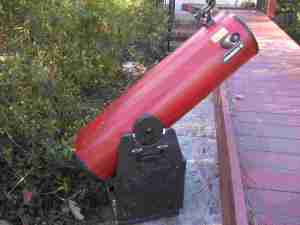
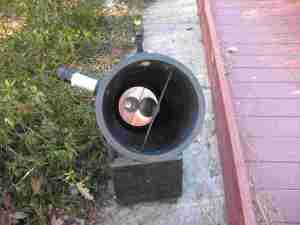
My 8 inch Dobsonian telescope

I bought this telescope in the 1980’s and it has served me well. The Dobsonian design has an interesting history which you can read on Wikipedia here. It is best used for faint objects like nebula and comets. My other telescope is better for planets and double stars, for example. where higher magnification is needed. Here are some pictures of the Dobsonian:

img_1255img_1257

Posted by: T. Boyd | January 20, 2009

Venus crosses in front of the Sun ( a rare transit)

On June 7, 2004, David R. and I attempted to see the planet Venus cross in front of the Sun. The attempt was fun, but unsuccessful. It was too cloudy, but even more importantly (and embarrassing for the author), we were looking 24 hours too early – the transit was to occur on June 8;  I discovered my mistake, but it rained on the 8th.

I just reviewed the NASA information about it. It is a rare event! The previous time had been in 1882. But the next time is not too far away: 2012 on June 6. Put that on your calendar!
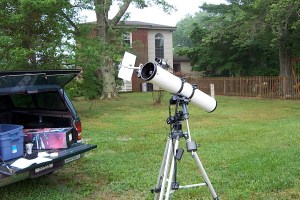
Here are some pictures from our attempt using a popular (but not very high quality) Meade telescope.

Setting up to see transit of Venus across the Sun

Setting up to see transit of Venus across the Sun

Projecting Sun's image on screen (3x5 card

Projecting Sun and clouds onto screen (3x5 card)

Posted by: T. Boyd | January 16, 2009

Some sights to look for

A new sight coming up is Comet Lulin, which is now an early morning, hard-to-see object, but will become brighter, reaching a peak brightness on February 23. I will keep you posted as I will be trying to see it myself.

Another exciting object is Venus, currently the bright evening “star” (actually, a planet) in the western sky after sunset. It is nearing its highest altitude and peak brightness. If you look through a telescope at Venus, you may be surprised to see its shape. It is not spherical looking, but goes through phases like the moon, and, right now, is crescent shaped because of where it is in its orbit around the Sun. The Sun is shining from the side, so to speak, from the Earth’s viewpoint. It reached the “half-moon” shape on January 16, and will be getting slimmer during the next few weeks, yet its brightness is increasing as it gets closer to earth.

Note: if you click on “half-moon” above you should see a short movie of its rotation from the Sky and Telescope site.

More to come…

Boyd

Posted by: T. Boyd | January 14, 2009

The theme

“But downward bends his wond’ring eye at mysteries so bright.”  (From Crown Him with Many Crowns).

For several issues of a short-lived Caroline County, VA newspaper in the 1990’s, I wrote a column on astronomy entitled IN THE NIGHT SKY, or something like that.  I really enjoyed writing the column, although the weekly deadline always seemed to come too soon. It is exciting to have a fresh incentive to get out during a cold evening or early morning to see some new or old sight in order to have something to comment on.

I have been an amateur astronomer for about 40 years and have never tired of observing old and new sights in the sky, and as my friends will tell you (some wearily), I always try to share the excitement with others, especially outdoors under a starry sky.

This time of year is my favorite season for evening viewing.  For example, Orion has been a life-long wonderful sight to see.  I’m sure almost everyone has seen it although it is frequently known by other names, such as the Little DIpper.  Several stellar groups are given this label, by the way, and the “real” Little Dipper, connected to the North Star, is relatively dim compared to Orion.

There are many web sites to encourage sky (sight-) seeing.  And I plan to write here what I have been viewing or studying.

You may send comments by e-mail to HeWillRejoice AT Yahoo Dot Com or leave your comments in the section below to be posted (after I review them).

“The heavens declare the Glory of God, and the sky above proclaims his handiwork” (Ps. 19:1, ESV)

Boyd

« Newer Posts

Categories