Posted by: T. Boyd | August 11, 2009

On, Comets! On Showers!… Dash Away All!

The title is a little corny, but it’s appropriate for the dogs days of August. Each year we celebrate our older son’s birthday on August 11. For years we went out on that night to observe one of the most reliable meteor showers of the year, the Perseid Meteor Shower.
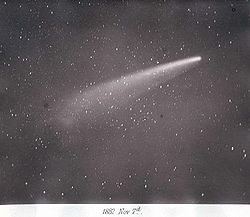
Great Comet of 1882 - Used by permission of WikiPedia

Great Comet of 1882 - Used by permission of WikiPedia

This light show of “shooting stars” is the dust left behind by the comet Swift-Tuttle first named after two astronomers that “discovered” it in 1862. It returned 130 years later in 1992, and is now thought to be the same
comet seen in 69 BC and AD 188 by the Chinese.

I will write more details about comets and meteors later when there will be another major meteor shower this fall and the readers can prepare to see it. Right now I will relate my wife’s version of our summer experiences. She writes:

“In the late night of Aug. 11 we customarily marked the occasion by lying on the ground counting meteors. Previous to going out we would darken the house to get our night vision going. Dad put out a blanket on the ground and summoned us.

“No flashlights were permitted, and getting into position in the dark was challenging. It took a few minutes for meteors to become more important than elbows and blanket share, but when we settled in, the event was memorable. Some of us took our pillows. It was always hot, often damp, and usually buggy.

“Our dog Penny licked our faces and was generally delighted that we were at last seeing the appeal of the outdoors after dark. Each of us wanted to see the most meteors, and we called out and pointed, all the while keeping track of our own personal total.

“We seemed to do best when we simply relaxed and didn’t try to focus too much on any particular area of the sky. Every once in a while, there would be a really spectacular one that seemed to streak across the whole sky. These brought oooh’s and wow’s and a sense that we were sharing something very special indeed.

“The boys and I usually lasted about 30-45 minutes before the bug repellent gave out completely, and the fans inside the house became irresistible. But Dad stayed out for usually another hour. His description at breakfast the next morning was a bit like a fisherman’s description of the one that got away.”

Her story makes me want to try again this year. So on Tuesday and Wednesday, weather permitting, I will probably take my truck out to a treeless site and try to count the meteors as I lie in the bed of the truck. I’ll report my score next week . [Author notes: both nights were cloudy and rainy, so I saw nothing.  But several friends in other states saw them.]

More about our Father’s glorious creation, about comets and meteor showers, can be found at BrightMysteries.net, or TinyURL.com/BrtMys, and you can write Boyd at BrightMysteries@verizon.net.

Posted by: T. Boyd | July 29, 2009

Orbiting the Moon

He never sleeps, He never slumbers
(Ps. 123:4, paraphrase & Take 6 song)

Recently, we celebrated the 40th anniversary of the space mission,
Apollo 11, during which two of the astronauts landed on the Moon –
a goal set by President John Kennedy in 1961, and accomplished in
July 1969, an amazing achievement in just 8 years.

To me, however, the most heroic part of the Apollo program was the
rescue of the Apollo 13 crew after a near-fatal explosion occurred
on the Service Module that supplied oxygen and electricity to the
whole spacecraft. The 3-man crew moved to the Moon Landing Module
(the LM) to be used as a lifeboat.

The Mission Control crew in Houston scrambled to figure out how to
get the 3-man crew back to Earth safely. To get the ship onto the
“free-return-to-Earth” trajectory, they would have to correct the
course that had already been set for the landing on the Moon.
Unfortunately, the LM had limited instruments to set up for a “burn”
of the maneuvering jets to do the correction.

Maneuvering in space is weird. For example, if you were orbiting
Earth in the space shuttle and you wanted to dock with the space
station ahead of you, you cannot just speed up toward the target.
You actually have to drop into a lower orbit by “slowing down” and
let the orbital dynamics carry you ahead of the target, and then
you go back to the target’s orbit by “speeding up”.

Mission Control devised a way by using an alignment telescope on
board the LM to check to see if the spacecraft’s jets were pointed
in the correct direction. At 73:46 hours into the mission, loud
cheer erupted inside the LM as well as in Houston that the chosen
navigation star (our Sun) was exactly where it should appear in the
telescope .

The Mission Control Flight Director, G. Griffin, recalled his
exhilaration at that time: “My God, that’s the last hurdle – if we
can do that, I know we can make it.” (quote from here near the end)
After they swung around the Moon, they fired the jet for 5 minutes making it possible to make it back to Earth with a splash- down time of 142:54 hours.

If you have watched the movie, “Apollo 13”, you know that there was
much more going on during the 6 day mission. They managed to rig
up filters with tape and plastic to remove carbon dioxide. They had
to severely restrict water intake to have enough to last till
splashdown. And they had to turn off the heat to save electricity,
making it hard to sleep at the freezing temperature of the LM.

People all over the world were watching and praying. Tears of joy
were shed and many prayers of thanksgiving went up from all over
the Earth at the moment they were safely home. God “who watches
over you will not slumber. Indeed, He … never slumbers nor sleeps.”
(Ps. 121:3-4)

This article published in the Caroline Progress, 2009. Also “blogged” at BrightMysteries.net.

Posted by: T. Boyd | July 14, 2009

Protons, Neutrons, and Such

He is the radiance of the glory of God and the exact imprint of his nature, and he upholds the universe by the word of his power. (Hebrews 1:3 ESV)

I was thrilled as a young graduate school student to get to work with a nuclear accelerator in a project to build a neutron detector. Unlike charged particles, such as protons and electrons, neutrons easily pass through the stainless steel walls of the vacuum chamber into the surrounding area. So the detector was placed on a stand about 6 feet away from the collision chamber. Thus only neutrons and gamma rays could reach the detector from the collisions

One big problem is that the detector was flooded with many more gamma rays than neutrons. But the flash of light produced by a neutron is slightly different from a gamma ray. Also gamma rays travel at the speed of light (since they are just high energy bundles of energy, or photons, like light, while neutrons cannot travel at that speed since they have mass.

The neutrons would travel the 6 feet in about 100 billionth’s of a second, much longer than gamma rays which would travel that distance in a mere 6 billionth’s of a second. The electronics, even in 1966 when I did this work, could use the time difference as well as the characteristics of the light flashes to filter out the gamma rays.

Neutrons are very strange. They cannot exist very long outside of a nucleus. They decay into protons and electrons in about 10 minutes in free space (actually that is their half-life – more about that sometime). And even though they have no charge, they will not stay with another neutron unless a proton is present. And, conversely, protons will not stay together unless neutrons are present.

Going further, we can see that nuclei are themselves strange. The number of protons and neutrons that a particular nucleus (an isotope) contains determines its stability, but not in a very logical manner. For example, stable hydrogen, which always has one proton, can have zero or one neutron, but two neutrons will make it unstable.

Helium, with two protons, is stable with one or two neutrons, but not three. As a person tries to predict the stability of an isotope as more protons and neutrons are added, he or she quickly finds great difficulty in doing so.

For instance, Beryllium with four protons, is stable with five or six neutrons, but not with only four neutrons. The pattern of nearby isotopes would seem to say that this nucleus ought to be stable with four of each.

For example, here is a list of stable (happy) and unstable (unhappy) arrangements:

Number of Number of   Stability        Name of Atom
protons   neutrons
   1         0       very stable        Hydrogen
   1         1       barely stable      Deuterium
   1         2       unstable           Tritium
`  2         0       very unstable      ---
   2         1       quite stable       Helium 3
   2         2       very stable        Helium 4
   2         3       very unstable      Helium 5
   3         2       unstable           Lithium 5
   3         3       stable             Lithium 6
   3         4       stable             Lithium 7
   4         3       unstable           Beryllium 7
   4         4       very unstable !!   Beryllium 8
   4         5       stable             Beryllium 9
   4         6       stable             Beryllium 10

The reason that Beryllium 8 is a surprise is because, being an even-even nucleus, it should be more stable than its siblings. For example a nearby isotope, Carbon 12, is very stable and prevalent on the earth, and it has 6 protons and 6 neutrons. And why should Tritium be less stable than Helium 3, with the latter having the protons repelling each other so strongly?

The atom is made up of a positively charged nucleus and the negatively charged electrons surrounding the nucleus. The force of attraction between unlike charges – as well as the repulsion between like charges – is called the electrostatic force can be described by a simple algebraic expression.

On the other hand, the nuclear force, which “glues” the neutrons and protons together in the nucleus is a puzzle. There has never been a simple explanation found for this mysterious force, actually called the “strong” nuclear force.  It requires advanced mathematics to give even an approximation of it. And the “weak” nuclear force is stranger still, requiring Einstein’s relativistic theory to even start understanding it. It is the force that causes the instabilities found in nuclei.

In all, there are 4 known fundamental forces: gravity, electromagnetic, the strong nuclear force, and the weak nuclear force. The first two have been adequately explained by laws that were discovered years ago by scientists, most notable of which were Isaac Newton (1643 – 1727), and James Maxwell (1831-1879).

The universe is held together by these various forces, that, like the material of the universe, were created out of nothing. In Hebrews 1, the scripture says “He … holds all things together by the word of His power.” The inventor of the world knows how He did it. Someday we will know, but maybe not till we see Him face to face.


Posted by: T. Boyd | July 7, 2009

Holograms

And we all, with unveiled face, beholding [or reflecting] the glory of the Lord,  are being transformed into the same image from one degree of glory to another. (2 Cor. 3:18 ESV)

Holograms are now used in many products, mostly as a security measure to help prevent forgery of credit cards or even of some currency.  When I examined my credit cards last evening,  one popular card showed a silvery image of a white dove in flight with wings outstretched.  By examining it under a small light source, I could see that it was a 3-D image of the dove, and by tilting the card slightly from side to side it even appeared to flap its wings a little bit.

The first holograms required laser light in the production and in the viewing of them (since then viewing in ordinary light has been made possible). About thirty-five years ago, several of my students tried making some.  It was a very exacting process, and we were not successful with our limited apparatus.

I have seen some very remarkable holographic displays in museums.  One such circular hologram depicted the head of a young lady, and as you walked around the film, you could see her whole head from every angle just as if she were in the center of the circle of film.  Her eyes even appeared to follow you as you moved.

The first experience of seeing this was breathtaking for me. When you looked over the edge of the holographic film, you saw nothing but empty space in the center of the circle. When the  light used to illuminate the hologram was turned off, the image disappeared.

Suppose the film were to be cut up into a bunch of small 1″ squares, for example, and handed out to the people looking on.  If you were there, as you looked through your piece of the film, you would see the lady’s entire head in 3-D from a particular angle.  For example you might see the head from her right side.  Another person might see the back of her head.

By swapping around the squares with each other, you would be able to see the image from every angle and acquire a complete picture of how the lady really looked. In like manner, every person on earth has been given a particular unique view of our creator, and as we share with each other about what we have seen and heard of him, we learn more and more about his glorious self, the unlimited treasure of our maker.

You can read more about the details at BrightMysteries.net   You are welcome to e-mail me at the link given at the bottom of the page.

By the way, as usual, this article, written by me,  is copyrighted by the Caroline Progress, Bowling Green, VA,and so it should not be published without their permission.  It is posted here with their permission.

Posted by: T. Boyd | June 25, 2009

Pure Light and True Light

The true light, which enlightens everyone…”

What is pure light? Or maybe the first question ought to be, what is light? Light is simply an electric-magnetic wave just like the waves of radio, TV, and x-rays except its wavelength is in the visible range. The wavelength of FM radio and the TV channels 2 through 13 (at least before the switch to digital TV) is in the range of 3 feet to 18 feet.

The wavelength for light is in the range of 15 to 30 millionths of an inch, very small indeed. X-rays have wavelengths that are much smaller still. Our human eyes can only detect the waves in the visible range. Our skin can detect the warmth of infra-red light (wavelengths longer than visible light) and can burn from ultra-violet light (wavelengths shorter than the visible ones).

What is pure light? The definition I have in mind is light that has only one wavelength. Most light that we see is made up of many different wavelengths. Sun light is a continuous mixture from the deepest blues to the brightest reds and all colors in between as a prism or a rainbow can show.

But a laser, for example, produces a very narrow range of wavelengths, or a single wavelength as far as our discussion is concerned. And like a pod (school) of dolphins swimming along in synchronization, all the waves produced by the laser are in lock-step with each other which keeps the light from spreading out very much. It is very useful light for medical and scientific uses because it can be focused so well.

What about true light? More of the quote above is: In him was life, and the life was the light of men. The light shines in the darkness, and the darkness has not overcome it… The true light, which enlightens everyone, was coming into the world (John 1:4-10 ESV).

Pure laser light is used in Lasik surgery, for example, to reshape the cornea of the eye to correct vision problems. And there are types of lasers used to remove unwanted tattoos.

Another use of pure light is to measure accurately the distance to the moon within one inch. This light is bounced back by reflectors left there in the late 1960’s and 1970’s at certain locations on the moon.

So just as pure light can be used in surgery to heal problems, and in astronomy to add accuracy to our measurements, the true light can be used to shine in the darkness of our world to reveal things that need revealing and to bring healing to our souls.

Posted by: T. Boyd | June 15, 2009

Two Faces of Light

For God, who said, “Let light shine out of darkness,” has shone in our hearts to give the light of the knowledge of the glory of God in the face of Jesus Christ. (2 Cor. 4:6 ESV)

The nature of light is fascinating. It has a dual personality, sometimes acting as tiny particles of energy called photons, and at other times as a continuous wave like a wave in the ocean.

One way to demonstrate both natures is to shine light through two very close, tiny pinholes, or slits, in a sheet of aluminum foil.  When the light, which emerges from the two holes, falls on a screen on the other side, it forms an intricate pattern of darkness and brightness.  If one of the holes is covered over, the pattern of dark and light disappears leaving a blob of light that is brightest at the center getting dimmer as you go out from the center.

images

(Note: images borrowed from Google images)

These results can be explained by considering light to be like water waves with alternating peaks and valleys.  When two such waves come together, there will be regions where the peaks and valleys combine to double the heights and depths, and other regions where they cancel each other, leaving the water surface calm.  Hence the pattern of the light on the screen is explained by saying light acts like a wave.

However, if the light intensity in this demonstration is dimmed so that only sensitive light detectors in an optics laboratory can detect it, then the light photons can be counted one by one, thus showing them to be individual tiny bundles of energy, each one traveling through one hole or the other.  And yet the light lands on the screen only in the formerly bright regions, not the dark regions, thus preserving the intricate pattern.  Here is what that would look like in a time exposure of very dim light for a short time on the left, and a little longer time on the right. 

images

Furthermore, if one hole is covered, this pattern disappears just as before. So the mystery is: how does the particle “know” that another hole even exists when it passes through one of the holes?  The distance between the holes is very large on the scale of the size of the light particles.  And yet just the availability of a second path somehow makes the particles either reinforce each other or cancel each other out.

These results seem contradictory and have fascinated me for years.  The mathematics that physicists use can explain the effect, but it does nothing for helping our intuition about it.  There is more.  Can you believe, that a similar experiment with beams of electrons, which are tiny charged particles, show the same pattern of reinforcement and cancellation on a phosphorous screen in a darkened laboratory?  It turns out that all subatomic particles, as well as atoms and molecules, have the same dual nature, acting as waves as well as particles.  Until next time…

Posted by: T. Boyd | June 15, 2009

How Far the Stars?

The heavens are telling the glory of God;
and the firmament proclaims his handiwork.
Day to day pours forth speech,
and night to night declares knowledge.
There is no speech, nor are there words;
their voice is not heard;
yet their voice goes out through all the earth,
and their words to the end of the world.
(Ps. 19:1-4 RSV)

Astronomers state that some distant galaxies are 15 billion light years away. How do they know that? They estimate this with a series of extrapolations. Only for nearby stars can the distance be measured directly. The others are indirect.

The first step in the process is to use the parallax method similar to the first kind of rangefinders used on golf courses or for hunting. This technique uses two lenses separated a few inches from each other, like a person’s eyes, giving two slightly different views of an object.

The two views are merged by an adjustment from which the distance to the object is produced. (Our brains do that automatically, so we can reach out and put our hands right on an object, or cast a fishing lure right where we want it to go.)

In the case of astronomy, the two views are taken 1/2 year apart, so that the earth has traveled to the other side of the sun between measurements – a separation of 186 million miles. About 100,000 star distances have been determined this way. The closest star (other than our sun) is about 4 light years away (the distance that light travels in 4 years), and the furthest one determined this way is about 3300 light years away.

An astronomer chooses a far away star and compares its color spectrum to the tabulated data to find a close by star that matches. They compare the brightness of the two stars. Knowing how brightness varies with distance, they can estimate the distance to this distant star. Simple? Not really, but it is logical.

The problem is that it is based on several assumptions. And the uncertainty in the distance measurement is significant. But it is the best that can be done at this time.

So, how far the stars? Even though the stars are silent, as the psalmist says, their “voice speaks” by their light, by their spectra. We can estimate that they are, indeed, very far away. Yet even at their great distance, they bring a grandeur and majesty to the night sky that has amazed every generation.

Posted by: T. Boyd | May 28, 2009

The Puzzle of the Years


“Let there be lights in the expanse of the heavens to separate the day from the night. And let them be for signs and for seasons, and for days and years” (Gen. 1:14 ESV)

Here is a list of words with Latin prefixes that are numerical. Can you spot what else they have in common?

Astrolabe (From WIkipedia)
– used by early astronomers
to locate heavenly bodies,
tell time, etc.

decimal (based on the number 10), Septuagint (seventy books in the Greek version of the Old Testament), novena (a nine day prayer cycle), and octagon (eight sided figure).

This discussion is again about time, its connection with astronomy, and, in this case, the history of the calendar.

Back to the puzzle. Would you recognize the common element if the prefixes are listed this way: Sep., Oct., Nov., Dec.? Yes! They are last four months of the year.

But why the contrast between the names and the positions of our last four months? At one time March was the first month of the year instead of January; then September was the 7th month of the year, October the 8th, and so forth. The change to making January the first month of the year instead of March varied from country to country.

England, for example, adopted the change in 1752 A.D. But the Romans chose in 153 B.C to make the new year start in January, because that was when the newly elected Roman consuls began their one-year tenures.


Another indicator of this change is the placement of the odd month of February. If March were the first month of the year, then February would be the 12th month, which is a logical place to put the odd month with its extra leap day every fourth year.

The common calendar of the Western world is called the Gregorian calendar based on the tropical (solar) year. It attempts to keep the winter solstice (the shortest day of the year) close to December 21, keeping the seasons the same from year to year. Actually, the previous common calendar was the Julian calendar, which had a leap year every forth year without exception. But it gradually drifted with respect to the sun and the seasons.

So the Gregorian one, proposed by Pope Gregory XIII in 1582, has the rule of not having a leap year during the turn of the century, with the exception of century years that are divisible by 400. Thus the years 1700, 1800, and 1900 were not leap years, but the year 2000 was a leap year. This modification will keep the seasons fixed for a long time . Not until about year 4000 A.D. will the error be noticeable.

I think that our creative Lord has a fine sense of humor to set the orbits of the earth and the moon in such a way that it takes so much work to keep track of time. Another one of His wonderful mysteries.

Give me some feedback at BrightMysteries@verizon.net.
or you can comment on this blog.

Posted by: T. Boyd | May 17, 2009

As the world turns slower

His eternal power and divine nature have been clearly perceived ever since the creation of the world, in the things that have been made.” (Romans 1:20 ESV)

The spinning of the earth is very gradually decreasing.  The length of a day, which was exactly 24 hours in 1820 will be one second longer in about 50000 years.  So the slowing is real, but I don’t think it will affect your beach time very much!

A granddaughter at the beach

A granddaughter at the beach

What is causing the slow down?  Our “giant” moon is the culprit.  Our moon is about 1/4 the diameter of its host, earth – much larger than other moons compared to their hosts.  This causes the ocean and land tides to be much higher than they would be with a smaller moon.  The tides create friction, so the energy taken away by this process causes the earth to gradually spin more slowly.

There is an interesting consequence of the slowdown.  It causes the moon to move away from the earth about 1.5 inches per year. Since man landed on the moon forty years ago, it is about 5 feet further away from the earth.  This change in distance has been verified with laser light bounced off the moon (the astronauts left a special reflector on the moon’s surface for this experiment).

There is an extension of Newton’s laws of motion and gravity called the law of conservation of angular momentum.  Since the angular momentum for the earth is decreasing, then that of the moon orbiting the earth has to increase to keep the total angular momentum constant.  Moving away from the earth preserves that balance.

As one of my less serious students at Caroline High asked during class, “Who made these laws, and why do we have to obey them?”  After the laughter quieted down, I explained that the laws of nature are used to describe the motion of the universe and they never have been violated as far as we knew.

Maybe next time I am at the beach along the Atlantic coast line, and notice the tide coming in or receding, I will be able to say, “Just think – that tide is making the moon move away from us about 0.004 inches every day.”  And along with praising the Lord for the beauty along the coastline, I can thank Him for helping us use our minds for discovering these scientific principles which help us understand the creation.

Most of these articles are also at a much faster-loading site:  http://TinyURL.com/BrtMys.

Posted by: T. Boyd | May 9, 2009

Heavenly Clocks, Part 2


He reveals deep and hidden things;
He knows what is in the darkness,
and the light dwells with Him.

(Daniel 2:22 ESV)

Last time I wrote about how Galileo’s discovery of the moons of Jupiter led to accurate determination of time regardless of location.  The British Royal Astronomer, John Flamsteed, published the first tables of Jupiter’s moons in 1707, after Galileo had proposed the method 90 years earlier.

Although sailors had learned to determine latitude (N/S), an accurate time piece was needed for determination of the longitude (E/W).  You need time to the nearest minute to resolve the longitude within 17 miles (at the equator).  If you know the time to the nearest second, you can know your east-west position within 500 yards.The problem remains that it is nearly impossible on a moving, rolling deck of a ship to use a telescope to see the moons of Jupiter.  In addition the weather and the position of the planet in the night sky have to be just right to make an attempt.

Grasshopper escapement invented by John Harrison

Grasshopper escapement invented by John Harrison

Since accurate clocks were sorely needed for ship navigation, the British Parliament in 1714 offered three prizes up to 30000 pounds Sterling for determining longitude on a voyage to the New World. The book, Longitude, written by Dava Sobel is an exciting, suspenseful story about John Harrison (1689 – 1776) who spent most of his life producing a series of five clocks to fulfill the requirements of the prizes.

In 1761, Harrison’s 4th clock, which looked like a large pocket watch, was only 5 seconds slow at the end of a two month voyage on the HMS Deptford from England to Jamaica – an error in longitude of only one nautical mile!  Can you believe it?  But this astounding achievement was labeled “just luck” by Parliament, and the prize refused, even though the requirement was to measure it within 30 miles!

He repeated the feat in 1765; once again the prize was refused.  Finally, he appealed to King George III, who insisted that Harrison be given the prize.  In 1773, at 80 years of age, he was finally rewarded by Parliament – but not the official award, which apparently was never given to anyone.

Harrisons 4th clock that met the challenge

Harrison's 4th clock that met the challenge

(The H4 clock is running again – click to see the BBC News article)

Although John Harrison was denied the official award, seafarers from that time forward were able to navigate accurately. The designer and maker of the wonders and beauties of our cosmos gave a gift to this man so he could in turn create such marvelous time pieces.
I praise You, for I am fearfully and wonderfully made. Wonderful are Your works. (Ps. 91:14 ESV)

« Newer Posts - Older Posts »

Categories