Pastor Bob Worley continues the lesson from last week: or click HERE to hear the lesson (you can “right click” it with your mouse to download it first).
Posted by: T. Boyd | July 12, 2012
Pastor Bob Worley July 10, 2012 at the Chick-Fil-A Bible Study
Posted by: T. Boyd | July 9, 2012
Rods, Cones, and Night Vision
Most of us have heard about how the retinas of our eyes are made up of rods and cones and how the rods are very sensitive even in dim light, but cannot distinguish color, while the cones are less sensitive to dim light but can distinguish color. There are 2 good articles I found on this. This one is by a college friend, Dr. Rod Nave, who wrote numerous physics articles before retiring from Ga. State University. The other one is a wikipedia article.
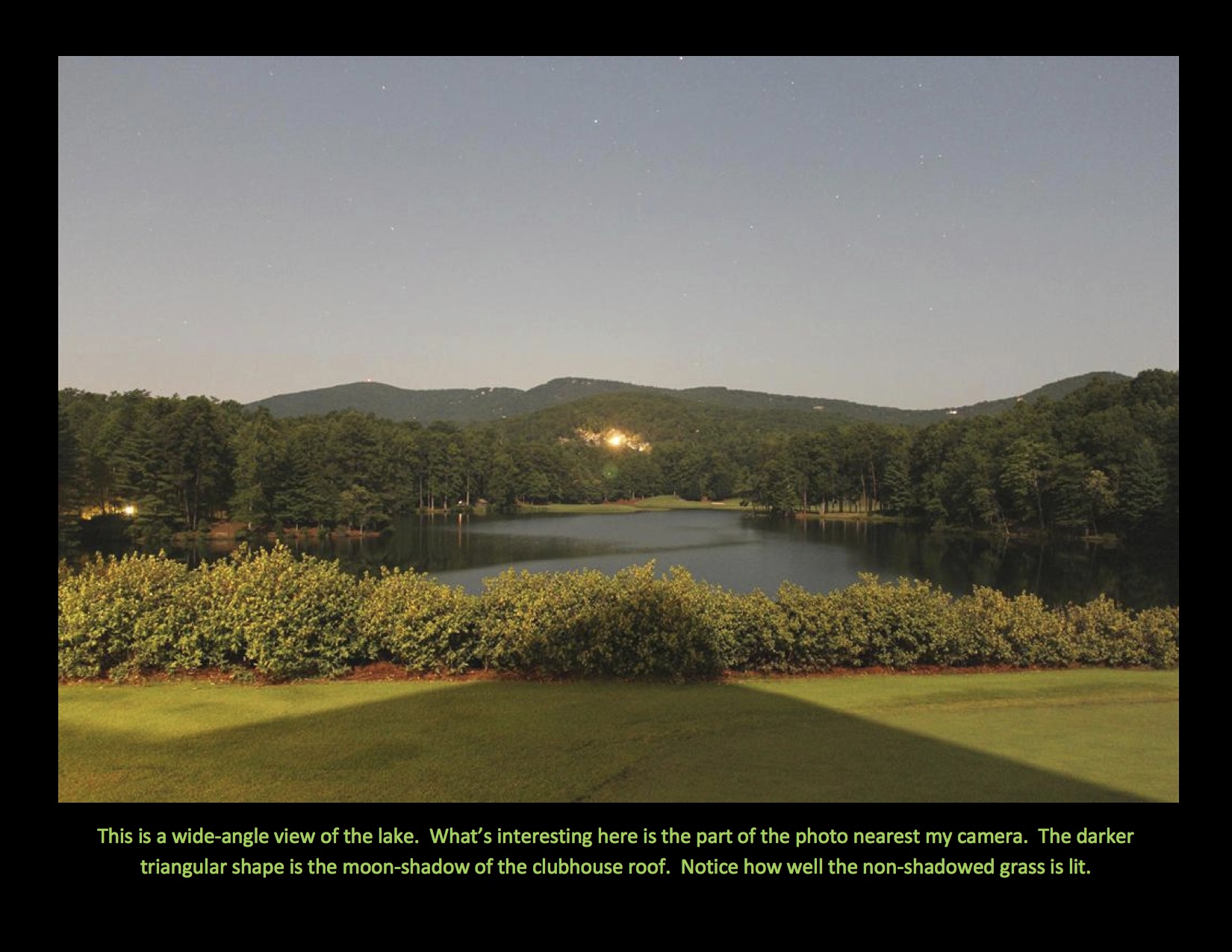
I was surprised years ago, when I took this night time photo to see that the trees had green leaves that showed in the moonlight to the film but not to my eyes. This was taken with an old 35 mm. camera using Kodachrome film. 
And recently, my friend Jim Tanner near Atlanta took some very nice shots after midnight which are just remarkable to me with their beautiful colors taken in moonlight. The second photo is his. And his pdf file showing all the pictures taken that night can be seen here. And he took another series shown in this file – notice the first two pictures are taken from the same location, one in the daylight and the other at midnight.
To me the wonders of our creation invented by our master of the universe are eternally praiseworthy. Blessed be the Father and God of our Lord Jesus Christ. Amen.
Posted in Here's looking, Physics
Posted by: T. Boyd | July 3, 2012
Pastor Bob Worley speaks at the Chick-Fil-A Bible Study
In our 1 John study, we are presently in chapter 4, and 1 John 4:13 says “By this we know that we abide in Him, and He in us, because He has given us of His Spirit.” Brother Bob picked up on that verse and talked about how the spirit dwells within us if we are born again. I love his mini-sermons that we sometimes are blessed with on Tuesday mornings, and I happened to catch this one: click this player button: or click HERE to hear the lesson (you can “right click” it with your mouse to download it first).
Posted by: T. Boyd | May 30, 2012
Science Projects for K-12 Students
My favorite part of teaching was helping science students do science projects, some of which even won state recognition. That was not the goal, but it put “icing on the cake”, so to speak.
There were several projects that stood out as rewarding experiences for the kids, and the results were sometimes noteworthy.
One example of that was testing all the various brands of alkaline batteries, including the top rated brands and the cheaper, bulk packaged ones.
We found in that study that the data indicated that there were only about 4 different sources of the batteries identified by their graphs of energy discharge vs. time, with the main difference being that the more expensive brands seemed to have tighter quality control, namely the cheaper brands seemed to have some early failures, while the premium brands did not. (But the limited sample size in our test may have led to a false conclusion). Here is a graph similar to what we found:

From the site: http://www.picotech.com/experiments/
Given the necessary time and energy, I will try to write some guidelines about experiments that seemed to work with my students, with enough details and illustrations to help any parent or teacher (or student) to be able to carry the research further. Also, I hope this can generate a forum toward helping with science projects for school.
In the meantime, I would like to have responses on these ideas as well as your own suggestions. Thanks. And have a blessed day in the Lord.
At the top of this page is a link to the main page where I am sharing ideas for projects. Or click here: Ideas for Science Projects
Posted by: T. Boyd | November 28, 2011
Deeply Deluded
The sentence in Richard Lovelace’s book, Dynamics of Spiritual Life, that contains the words, “deeply deluded,” caught my attention. (You can click on the link to read the excerpt). The reading is not easy, but that passage says to me that I don’t want to admit that I cannot win the battle that rages between my old self – the part of me that is angry and hateful at times – and the new life that I have been given in Jesus.
I am deeply deluded into thinking that I can overcome those things if I just keep trying hard enough. And I think if I can just understand the causes of this bad nature that are hidden away in my subconscious, then maybe I can then master myself and prevent that type behavior. I have exerted much energy in this futile exercise over a major part of my lifetime.
And Lovelace puts his finger on the very reason I hang on to this misconception: “…we do not want to face the despair of having to live in conscious helpless awareness of [sin’s] tyranny, [afraid of] abusing the grace and forgiveness of Christ.” In reality it hurts my pride to think I have to keep getting help from Jesus. Gratefully I have experienced his grace in forgiveness for past sins in order to be reconciled to God. To me it seems unfair to have to lean on him to also get rid of the bad behavior to which my new conscience has been made sensitive.
I want to say that I have been traveling this fruitless path for at least 50 years, always making an excuse for some bad behavior (for example, yelling at my wife unjustly), then repenting and resolving never to commit that offense again. And I can report that this striving to conquer my bad nature on my own does not work. I accomplish very little toward changing my old nature; I can only temporarily tame it.
There is only one way out of this “maze of twisty little passages all alike” 1.” And that way is found at the same place that our salvation was found: at the cross where Jesus died for us. Only Jesus has the power to destroy the tyranny of sin over our lives. As Lovelace says, who is quoting Paul, “…we have died with Christ, and have been raised up together with him in newness of life. Therefore we are not to set the estimates of our power to conquer sin according to past experiences of our will power, but are to fix our attention on Christ and the power of his risen life in which we participate: for we have died and our life is hidden with Christ in God.”
At least one more thing needs to be said about this sanctification process: it is an on-going, daily decision that I must make. Will I this day allow the power that is in the life of Jesus Christ do its work in me? Or will I be foolish to think I can walk alone without faltering today? Again, from experience, I can bear witness that every time I decide not to trust Jesus for my source of strength, that I soon find that I have “wandered into desert wastes, hungry and thirsty, my soul has fainted within me” (Psalm 107, paraphrase). My joy is gone; I retreat into my “shell” and wallow in self-pity, wondering what went wrong.
“Wretched man that I am! Who will deliver me from this body of death? Thanks be to God through Jesus Christ our Lord” (Romans 7:25 ESV). As soon as I “cry to the Lord in my trouble, he delivers me from my distress”(Ps. 107). One more chance to learn not to go it alone.
Posted in Christian meditations, Here's Thinking, Theology
Posted by: T. Boyd | August 15, 2011
Enjoying Life by Living in Reality
I shared a testimony at East End Fellowship yesterday about this past year’s teaching on the Sermon on the Mount. I talked about the passage ending “But seek first the kingdom of God and his righteousness, and all these things will be added to you.” (Matthew 6:25-33).
I think that this verse describes my goal in life, and, by faith, I say I believe that I belong to another kingdom other than this earthly one; I agree with Ephesians 2:6: “God… raised us up with him and seated us with him in the heavenly places in Christ Jesus,”, that I am truly seated with Christ in the heavens.
But do I really practice this? Is this real to me? I would say for the most part I do not live in the reality of this. Why not? The problem is that this heavenly kingdom is not visible; I cannot know it with my 5 senses of seeing, touching, smelling, tasting, or hearing. This reality is sensed only spiritually, and that sensing is not easy for us earth-bound creatures. If I ask myself, “How much of my time am I aware of God’s kingdom, or, how much of my mental processes are focused on the Lord Jesus?” I find myself coming up with a low score on this scale.
What can change this condition of not living in the reality of the heavenly kingdom? Notice that I am trying to avoid the question, “What can I do about it?” Unlike Yoda’s advice to young Luke in Star Wars, it is not about trying, nor is it about doing something. Jesus was asked this in John 6:28-29 “Then they said to him, “What must we do, to be doing the works of God?” Jesus answered them, “This is the work of God, that you believe in him whom he has sent.””
Because the work has been finished, and it is complete, there is nothing more that I can do to add to what Jesus has done. Paul said, “The fullness of the Godhead bodily dwells in our Lord, and we are complete in Him.” (Colossians 2:9-10). I simply need to abide there, live in Jesus. But, how do I abide in Him instead of mostly living elsewhere?
Paul says earlier in Colossians 2:6-7, (from The Message) “My counsel for you is simple and straightforward: Just go ahead with what you’ve been given. You received Christ Jesus, the Master; now live him. You’re deeply rooted in him. You’re well constructed upon him. You know your way around the faith. Now do what you’ve been taught. School’s out; quit studying the subject and start living it! And let your living spill over into thanksgiving.”
I need to see – more than see, but know – in my heart that this is where my deepest need and fulfillment is found. It is what I was created for. The ancients asked: “What is the chief end of man? Answer. Man’s chief end is to glorify God, and to enjoy him for ever” – And this is true. There is no real living, real fulfillment, real happiness elsewhere.
I can find a hint of this way of living when I recall every time I been surprised by one of those sweet times of joy, those almost painful longings of my soul for something of beauty, of love, of peace, that have come suddenly before me in my walk down the path of life. Isn’t there something eternal in those times? I declare, “yes, there is.”
Maybe it is seeing something beautiful in the sky, or in the garden, or in an act of kindness that someone does for another person. Or it can be in the sudden understanding of a verse of scripture that has never opened up before. These events surely are arranged by the Holy Spirit – He is whispering to my heart how great is His love for me and you.
And when I acknowledge this in glorifying Him, I find true happiness pours out upon me in blessings – this is enjoying Him forever. It does not have to be just for a rare occasion; this is what Jesus found at all times, and longs for us to find – “that they may have my joy fulfilled in themselves.” (John 17) and “These things I have spoken to you, that my joy may be in you, and that your joy may be full.” (John 15)
I just need for my heart to be convinced and frequently reminded that this place of real joy and happiness is found only in Jesus. If my heart is convinced in that truth, I will quit wasting time chasing the things of the world that only bring false and temporary pleasure.
C. S. Lewis said, “Indeed, if we consider the unblushing promises of reward and the staggering nature of the rewards promised in the Gospels, it would seem that Our Lord finds our desires not too strong, but too weak. We are half-hearted creatures, fooling about with drink and sex and ambition when infinite joy is offered us, like an ignorant child who wants to go on making mud pies in a slum because he cannot imagine what is meant by an offer of a holiday at the sea. We are far too easily pleased.”
What Lewis says is true – I mostly stumble through my day, indulging in one of my favorite pastimes, or maybe trying to achieve something, striving after some goal that will bring some sense of achievement, maybe, but, alas, I find its reward is so shallow and fleeting.
On the other hand, when I am able to “practice the presence of God” throughout the day, I finally start finding real peace and fulfillment. I suggest that this starts by deliberately setting aside a time each day to enter into my prayer closet and like Mary, linger at the feet of Jesus for a little while, learn who He is, what His aroma is like, what His tone of voice sounds like, what He is feeling, learning how can I serve Him, asking in what way can I join Him in serving others. And then afterwards arising and going out in that knowledge which strengthens me.
And I can sing to Him. I find it easy to think of Him by worshiping in music with my voice or playing keyboard for Him. I can write love letters to Jesus – it helps to keep a prayer journal, jotting down my requests and following up to praise God for the answers, which may come only years later, but brings a thrill when I realize the answer came.
I also find great help in memorizing scripture – this keeps on feeding the soul and spirit for days and years afterwards. I was able, at the peak of this practice, to memorize 18 or so complete Psalms – this totally surprised me because I have never been able to memorize anything before, at least, not without great effort. Many a night have I been able to get rid of insomnia by rectiting Psalm 1, Psalms 8, 19, 23, and 27. (For a blessing, watch John Piper quote from memory for some 20 minutes many passages of scripture: http://tinyurl.com/johnpiperquotes)
One thing that is not easy for me is to seek friendship with others – I am a loner by nature; but when I spend real quality time in conversation with another believer, and if it is centered on Jesus, I find that there is a third person always there – Jesus, Himself. It reminds me each time it happens that 2 or 3 together in His name is a natural gathering where He promises to be in a special way.
So, these are some practical ways of starting to seek the kingdom of God, of living in the reality of the eternal life with which God has gifted us. It boils down to living, abiding in the vine which is Jesus, and letting His life flow through me.
May the Lord teach me to be sensitive to those many times I tend to hurry away from the abiding because I suddenly have an idea of my own of something more worthwhile that I need to do, or because something happens to me to take my eyes off of His glorious face; or, more typically, of reacting to something that offends me and I grab my old defensive weapons to protect myself instead of trusting Him.
And gradually, He changes me, molds me into a true citizen of heaven, one who abides there and greatly desires with my whole heart to stay there forever.
May the Lord gently, but firmly turn my eyes away from myself and focus on Him. Amen.
Posted in Christian meditations, Here's Thinking, Theology
Posted by: T. Boyd | August 11, 2011
The Annual “Mars as Big as the Moon” Hoax
Every year since 2003, in August, an e-mail hoax has been released upon the public saying that on August 27 Mars will appear to be as large as the full moon. It will claim that Mars is at a record setting minimum distance from Earth on that date, and to be sure to not miss this once-in-a-lifetime chance to see this wonderful phenomenon.
This is not true. And the claim about the size comparison with the moon is also false. Here is a brief history of this story.
On August 27, 2003, Mars did get a tiny bit closer to the earth than usual. The 2 planets are on the same side of the sun every 780 days or so, and that year it was the smallest distance that it has been in thousands of years. How much closer? And when were the other close times in recent years? Here is a table showing how much bigger Mars appeared to be in 2003 compared to other years when it was close or will be close.
| Year | Month | 2003 was this much larger |
|---|---|---|
| 1956 | Sep | 1.41% |
| 1971 | Aug | 0.80% |
| 1986 | Jul | 8.19% |
| 1988 | Sep | 5.37% |
| 2018 | Jul | 3.29% |
So you can see that, even though it was unusually close in 2003, it was not something all that rare.
The other misleading statement is about the size compared to the moon. The original story said that if you looked through a telescope at 50 power, Mars would appear in the telescope to be about the same size as the full moon appears to the naked eye. That is quite a different story.
By the way, the next “closest distance” will be next spring, on March 3, 2012. The last previous time was January 10, 2010.
Posted in Uncategorized
Posted by: T. Boyd | June 22, 2011
What are you doing here, Elijah?
This question comes twice in 1 Kings, chapter 19. Elijah answers the question each time with the same words. But before the question is repeated, Elijah experienced the wind, the earthquake, and the fire, and then Elijah wraps his face in his cloak when he hears the “still small voice”. God repeats His question, “What are you doing here, Elijah?”
Even though Elijah used the same words in his second answer, I think it was spoken differently. In a google search on this question, I found no one else whose thoughts on the scene are in line with my own, so I don’t claim to have any evidence to support my ideas. But I think that the 3 displays of God’s power must have shaken Elijah. And when he answers the second time, “I have been very jealous for the Lord…,” I feel he spoke in a different tone of voice.
Maybe the first time he gave the answer it was done in a self-righteous, offended tone of voice; and the second time in a broken, heart-felt complaint to our Lord. Has anyone else had thoughts about this? Was there any change in Elijah between the two replies?
I am interested in your thoughts about this impression.
Boyd
Posted in Uncategorized
Posted by: T. Boyd | June 19, 2011
Vengeance is mine. I will repay, says the Lord.
The above title phrase is found in the book of Romans. My reaction to that phrase has always been to wonder about God’s anger and reconciling it with His love for mankind. It dawned on me this time in reading Romans, chapter 12, that Paul is warning us not to take out vengeance ourselves. “Beloved, never avenge yourselves, but leave it to the wrath of God, for it is written, ‘Vengeance is mine, I will repay, says the Lord’ ” (Romans 12:19 ESV).
Why not let us do the repaying? Because, our Father is merciful. There is a good chance, given time, that His Spirit can work on that person and bring him to repentance, and let the payment that has already been evoked to repay that debt – namely, the debt paid for all sin by His Son, Jesus Christ.
I don’t understand how this recompense works out, but somehow the new birth that happens when a person accepts God’s salvation enables his guilt and debt to be transferred to the work of redemption of Jesus at Calvary. Does that mean that if a person does not become a child of God through this miraculous gift that he has to pay the debt himself? I don’t know. Maybe someday this will become clear to me also. [Edited on 13Nov.2011: Actually scripture is clear that all will be judged. And the penalty of rejecting God’s gift of His Son is severe! My confusion was along the line of “double payment” that Doug introduces in the comments.]
Until then, I will stick to one of my fundamental assumptions about God: He is just, He is fair, and when all is said and done, and “I shall know fully, as I am fully known” (1 Corinthians 13:12), then I will continue to say, “He did it perfectly – well done, Father!”
Amen.
[Edited on 20Nov.2014: I don’t think the phrase above,
“but somehow the new birth that happens when a person accepts God’s salvation enables his guilt and debt to be transferred to the work of redemption of Jesus at Calvary”
uses the correct verb phrases. Maybe a better phrasing would be:
“but somehow the transformation of the new birth through God’s provision of salvation embraces the transfer of the payment of his guilt and debt to Jesus upon the cross.”]
Posted in Christian meditations, Theology
Posted by: T. Boyd | June 18, 2011
Spiritual Worship or Reasonable Service (Romans 12:1)
I have often wondered about the phrase in Romans 12:1, “I appeal to you therefore, brothers, by the mercies of God, to present your bodies as a living sacrifice, holy and acceptable to God, which is your spiritual worship.” (ESV) or “I beseech you therefore, brethren, by the mercies of God, that ye present your bodies a living sacrifice, holy, acceptable unto God, which is your reasonable service.” (KJV)
I like the explanation I found in the PuritanBoard site:
This, Paul says, is your spiritual worship, an expression that could be understood as KJV, “your reasonable service.” There are problems relating to both adjective and noun. Today most interpreters understand the adjective as spiritual, which makes good sense and is certainly in mind. But it is hard to think that the connection with “reason” has been completely lost, and there is something to be said for “intelligent worship” or J.B. Phillips’ version: “that is worthy of thinking beings”. In any case it is a striking word to use in connection with the offering of the body. The noun may be understood of service in general or of the particular service rendered in the act of worship. Harrison sees “service” as having the advantage that it “covers the entire range of the Christian’s life and activity.” But in the end we are left with the fact that Paul has used two words, both of which are ambiguous. We cannot feel confident that either “spiritual” or “rational” is absent from the adjective or that “worship” or “service” is lacking in the noun. There is a “rich complexity” (Leenhardt) in the expression. (From Morris, L. (1988). The Epistle to the Romans (434). Grand Rapids, Mich.; Leicester, England: W.B. Eerdmans; Inter-Varsity Press)
Finally, I can rest, at least for a while, in that intellegent, resonable, and, I think, spiritual answer. Thank you, Dr. Leon Morris, for writing that, and Dennis E. McFadden for posting it.
Posted in Christian meditations, Theology
Categories
- Atomic/Nuclear Physics
- Bible Study
- Books
- Boyd's Science Equipment
- Christian meditations
- Cochlear Implant
- Creation
- Here's Thinking
- Here's looking
- Introduction
- Justice
- Music
- Pastor Bob Worley
- Physics
- Published in Caroline Progress
- Racism
- Relativity
- Songs
- Static Electricity
- Theology
- Uncategorized
- White Corpuscle – Neutrophils
 Mysteries So Bright