Posted by: T. Boyd | June 15, 2011

Shall I extend the scepter (or use it as a club)?

The Lord Jesus continues to chip away at the old self.  This one showed His sense of humor.

I was in my favorite domain – my garage – yesterday.  My wife had a question for me.  She approached the garage door, stood there for a moment, and smiled at me when I looked up, probably with my serious face, since I was busy.  She asked her question.  I gave my answer.  And she walked back to the house.

And the Lord nudged me, “Do you think she feels like Esther?”  I wondered about that, and immediately found the need to repent of this still-another “blind spot” that I have failed to see.

I went into the house and asked her, “Do you sometimes feel like Esther?”

She turned and immediately replied, “Oh, yes!”

I said, “What do you mean by that?”

“Like Esther entering the throne room of the king and hoping he will extend the scepter instead of having my head chopped off,” she replied lovingly.

My heart melted and I asked for forgiveness through tears of laughter as we hugged and found comfort in one more chink in my armor being identified, and by faith, corrected.

Thank You, Father.
Posted by: T. Boyd | May 4, 2011

God and man at table are sat down

I was reminded this morning of an old song I learned years ago: God and Man at Table are Sat Down.  I was reading Exodus 18 and ran across this phrase (verse 12) “And Aaron came with all the elders of Israel to eat bread with Moses father-in-law before God.

There is something really special about breaking bread with others, but imagine it – it also occurs later again in chapter 24 of Exodus – God spreads a table for His children “They beheld God and ate and drank” (Ex. 24:11). These pictures which are a foretaste of the Lord’s supper observed by Christians throughout the years bring a thrill to my soul every time I run across one of these events in the scripture.

They cause me to bow down and join in with the psalmist, “What is man that you are mindful of him?” (Ps.8:4).

Posted by: T. Boyd | March 14, 2011

Nature’s pruners

There are four things on earth that are small but unusually wise ( Proverbs 3:24 – New Living Translation)

The writer of Proverbs goes on and talks about the ant, the rock badgers, the locusts, and the lizards, but he could have included the beetle as well.  Our Father, the designer and maker of all the wondrous creatures on the earth, shows His care for tiny details in the amazing insects spoken of here.

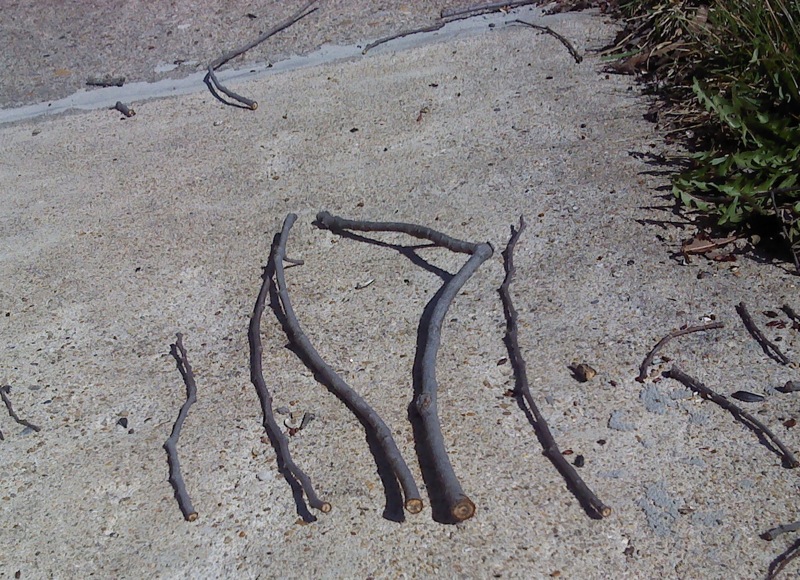
Have you wondered about all the twigs and small branches that fall to the ground under a hardwood tree this time of year? The ones I am talking about are those that look like they have been cut and not just broken off. An older friend explained this annual event to me several years ago, and I was reminded about it this year – our new home has a large deciduous tree in the backyard with dozens of these cleanly pruned stems lying on the ground under the tree. Here is a photo of some of the twigs that I gathered:

twigs pruned by twig girdlers

I think the scientists call this symbiosis – where one biological species helps another. And, as always, I think it was God’s intent for these arrangements to be made, not, as many think, an accident of the survival of the fittest.

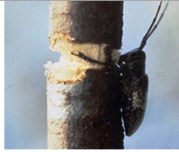
He made at least two insects that prune these trees each year: twig girdlers, and twig pruners. They are both small beetles, but do the pruning in significantly different manners. The girdler adult beetle selects a small limb to crawl out on, goes near the end – typically 1 foot from the end – and girdles the twig by cutting the bark all the way around. Then she lays one or more eggs in incisions made on the rim of the cut on the side away from the trunk of the tree. This is usually in the early fall season. About a month later, the egg will hatch, and the larva will start eating inside the bark.

The larva would die in a healthy limb, but does well in the damaged tip. Eventually the end of the limb will break because of the wind or other weather affects (sometimes the limb will stay attached, but hang down by a “thread” of wood fiber). The larvae  continue eating several months inside the dead twigs and emerge as an adult beetles in the late summer. Then the cycle begins again.

The photo on the left shows an adult twig girdler at work (from U of Florida, Gardening Solutions).   The one on the right is a photo of an adult twig pruner
from Rainbow Treecare
.

Screen Shot 2017-10-04 at 2.41.54 PM

Twig Gridler

twig pruner adult

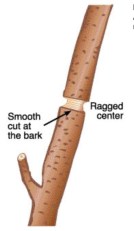
In contrast to the girdler beetle, for the pruning beetle, it is the larva that does the cutting. The adult female cuts a hole in a twig near the end, doing this in the spring. When the larva hatches, it begins eating the wood, and finally tunnels around near the peripheral, making a circular cut around the twig, but from the inside, leaving the outside layer of bark uncut. But, again, the wind will cause the weakened tip to break off later in the year. The only difference in the broken twig’s appearance between the pruner is that the outer bark will have a ragged edge where it broke off compared to the girdler – which leaves a clean cut. The diagram below shows the difference – you can click here for more information, and thanks to University of Missouri for supplying the diagrams and for how to control the infestation when it gets out of hand.

Screen Shot 2017-10-04 at 3.40.27 PM

Adult female twig girdler chews a V-shaped groove from the outside inward, leaving a ragged center where the twig breaks and a smooth cut on the outside near the bark.

Screen Shot 2017-10-04 at 3.40.50 PM

Full-grown twig pruner larvae chew through the wood from the inside outward, leaving a smooth cut on the inside of the twig with ragged edges near the bark where the twig breaks.

Again, the mysteries of creation, speak of the wonderful creativity, and may I say, it also tells of the sense of humor for the variety of funny looking creatures by our wonderful Father in heaven, and His Son, Jesus, through Whom the creation was made. “For by Him all things were created, both in the heavens and on earth” (Colossians 1:16)

Posted by: T. Boyd | February 12, 2011

Why stars twinkle (and planets do not)

Long ago God spoke many times and in many ways to our ancestors through the prophets.  And now in these final days, he has spoken to us through his Son. God promised everything to the Son as an inheritance, and through the Son he created the universe.  The Son radiates God’s own glory and expresses the very character of God, and he sustains everything by the mighty power of his command. (Hebrews 1:1-3 New Living Translation)

Why do stars twinkle while the light from planets looks steady?  The first part of the question is easier to answer than the second. Here’s a hint – the stars do not twinkle when viewed from the space station or from anywhere above the earth’s atmosphere. You guessed it: the twinkle is caused by turbulence in the air as the light beam passes through.

Then why do not planets also twinkle? As an example, if you look at Jupiter (in the western sky in the early months of 2011 after sunset) and compare it to a bright star, like Sirius which is the brightest object high in the eastern sky at the same time, you can tell that Sirius has a beautiful sparkling, wavering appearance that you do not see with Jupiter.

One way to explain this is that Jupiter’s diameter is very large in our view compared to Sirius (in a telescope, you can see that Jupiter is a round ball with surface features, while Sirius stays as a single point of light – even in the most powerful earth-based telescopes). Because of the size of the planet, there are many paths of light between the planet and us on earth. So even though each path of light is wavering because of the atmosphere, the average between all the paths to reach the eye looks steady. The eye blends them together into a sight that looks unwavering; therefore a planet doesn’t appear to twinkle.

But, you might point out, surely Sirius, the brightest star in our night sky, is much, much larger than Jupiter. In fact, its diameter, estimated to be 90 billion miles is more than a million times Jupiter’s diameter of 83 thousand miles.  One the other hand, because Jupiter is so much closer, the apparent diameter (as it looks to an earth based observer) of Jupiter is about 8000 times that of SIrius.

This, in turn, means that the apparent size in area of Jupiter is about 64 million times as big. So if we think of Sirius as having only one path of light hitting our eye, then Jupiter would have about 64 million paths to send its light rays to our eye. And the result is an averaging of all those paths to our eye to give the appearance of a steady light from the planet.  In other words, the wavering is smoothed out.

Whew! That’s a lot of words to explain a simple idea, but I hope it helps you understand what is happening when you see the steady light of  Venus, Mars, Jupiter, or Saturn  compared to the surrounding stars. Note: you rarely see Mercury since it stays very close to the Sun, and the other planets, Uranus, Neptune, and Pluto are too faint to be seen easily.

The other lesson learned here is how very far away are even the nearest stars  (Sirius is in the family of  about a dozen nearest stars – those that are less than 10 light years away.   The closest, Proxima Centauri, is about 4 light years away). Most of space is empty of stars and planets.

The universe is unimaginably immense, and yet our God who is its creator and sustainer is much greater.   The bible says that it was created through Jesus Christ, and that is sustained by the word of His power. (Hebrews 1:1-3)  God is incomprehensively powerful. majestic, and glorious, and yet He loves each one of His creatures.  Our names are written on His hand (Isaiah 49:16). Do you know that He loves you and me with His whole heart?

Posted by: T. Boyd | January 14, 2011

My God! I Know, I Feel Thee Mine

MY GOD! I KNOW, I FEEL THEE MINE

1. My God! I know, I feel Thee mine,
And will not quit my claim,
Till all I have is lost in Thine
And all renewed I am.

2. I hold Thee with a trembling hand,
But will not let Thee go,
Until by faith I firmly stand
And all Thy goodness know.

3. My Jesus, Thine victorious love
Shed in my heart abroad;
Then shall my feet no longer rove,
Securely fixed in God.

4. O that in me the sacred fire
Might now begin to glow,
Burn up the dross of base desire,
And make the mountains flow!

5. O that it now from heaven might fall,
And all my sins consume!
Come, Holy Ghost, for Thee I call,
Oh burning Spirit come!

6. Refining Fire, go through my heart,
Illuminate my soul;
Come spread Thy life through every part,
And sanctify the whole.

By Charles Wesley, 1707-88

Posted by: T. Boyd | December 15, 2010

Above the Deep Intent

Two days ago I prayed a somewhat weak prayer for strength to overcome my persistent feelings of fatigue and lassitude.  And then, as usual, I was pleasantly surprised that the answer came: I realized later in the day that I didn’t feel so tired – I had forgotten myself and just went about several hours doing things that needed to be done.  And then this morning, when a newly acquainted neighbor, Debbie, asked for help to start her car, the tiredness just dissolved in my response to her request.

Help me, Lord, to “build above the deep intent, [ and follow through to] the deed, the deed.”   From:

A Prayer by John Drinkwater

LORD, not for light in darkness do we pray,
Not that the veil be lifted from our eyes,
Nor that the slow ascension of our day
Be otherwise.

Not for a clearer vision of the things
Whereof the fashioning shall make us great,
Not for remission of the peril and stings
Of time and fate.

Not for a fuller knowledge of the end
Whereto we travel, bruised yet unafraid,
Nor that the little healing that we lend
Shall be repaid.

Not these, O Lord. We would not break the bars
Thy wisdom sets about us ; we shall climb
Unfettered to the secrets of the stars
In Thy good time.

We do not crave the high perception swift
When to refrain were well, and when fulfil.
Nor yet the understanding strong to sift
The good from ill.

Not these, O Lord. For these Thou hast revealed,
We know the golden season when to reap
The heavy-fruited treasure of the field,
The hour to sleep.

Not these. We know the hemlock from the rose,
The pure from stained, the noble from the base.
The tranquil holy light of truth that glows
On Pity’s face.

We know the paths wherein our feet should press,
Across our hearts are written Thy decrees.
Yet now, O Lord, be merciful to bless
With more than these.

Grant us the will to fashion as we feel,
Grant us the strength to labour as we know,
Grant us the purpose, ribbed and edged with steel.
To strike the blow.

Knowledge we ask not ‚knowledge Thou hast lent,
But, Lord, the will ‚there lies our bitter need,
Give us to build above the deep intent
The deed, the deed.
Posted by: T. Boyd | December 13, 2010

The Geminid meteor shower is tonight! (Dec. 13-14)

The geminid shower is tonight – this article says it has become maybe the best annual “shooting star” show.  It comes from the asteroid Phaethon, they think – it may be the core of a “dead” comet.  This is a space rock about 3 miles in diameter that has a 3 year orbit around the sun.  In Richmond it is supposed to be partly cloudy after midnight and this will be after the moon sets, so maybe I can see something.

http://news.nationalgeographic.com/news/2010/12/101213-geminids-meteor-shower-peak-december-science-space/

Let me  know if you see any.
Boyd
Posted by: T. Boyd | September 15, 2010

Down Labyrithine Ways

The writer told of a thread running from end to end of man’s history and said it was like the thread of Theseus. That Greek myth relates how Theseus was going into the Labyrinth from which no man ever found his way out again to kill the monster Minotaur.

The princess Ariadne offers Theseus a thread to unravel as he explores the dark maze so he can escape if he survives the quest. That scene stirred my memory of Mark Twain’s story about Tom Sawyer and Becky being lost in a cave.

The tender love of the two toward each other described in that tale made me long to be as Tom in comforting his friend. I think this was the first time that romantic love arose in my young heart. In the words of C. S. Lewis, I was surprised by joy.

And now some 60 years later, some of those expressions of rapture in my heart are opening afresh, better and more vivid than ever before. The poem by Francis Thompson, The Hound of Heaven, for me captures the essence of the ongoing pursuit for joy that I thought was initiated by me, but indeed, it is I who was being pursued.

The source of this fountain of joy, this welling up within my soul, is none other than my heavenly lover, the Lord Jesus Christ! Blessed be His Name!  Sometimes I feel like my heart might burst if I cannot share these feelings with others.

Someone asked, “Do you know that He loves you with His whole heart?” That question brought me up short. How can that be? How can the creator and king of the universe care about me, about each one of us? What is it about us that is worthy of love, of His trying to capture our hearts? Finding that answer is also part of the unfolding mystery of this marvelous love.

Oh how I wish I had the words to describe these experiences. How I long to bring others into the same gallery of riches and glory, to the place that Paul described, “Oh, the depth of the riches both of the wisdom and knowledge of God. How unsearchable are His judgments and unfathomable His ways…For from Him and through Him and to Him are all things, To Him be the glory forever. Amen.” (Romans 12:33-36)

…I fled Him, down the labyrithine ways
Of my own mind; and in the mist of tears
I hid from Him…

Halts by me that footfall:…
…His hand, outstretched caressingly…
“…I am He Whom thou seekest!
Thou dravest love from thee, who dravest Me.”

–Francis Thompson

Click here for Message by Bob Worley 28Aug2010

or try this one:

This was an excellent sermon preached by Pastor Bob at First Freewill Baptist Church, Richmond, VA.  You can write Boyd at BrightMysteries@verizon.net for further information.  If the link doesn’t work, please let me know. Thanks. By the way, since Pastor Bob’s 93 birthday was 2 days later, we sang happy birthday to him – I noticed he joined in on the singing. 🙂

Posted by: T. Boyd | September 1, 2010

The Missing Core of the Manhattan Declaration

Last November (2009) I got an e-mail requesting me to sign the Manhattan Declaration. After reading through the information my wife and I signed it to show our support.

A little while later I discovered that several of my “heroes” of the faith had posted statements about why they had not signed it. These included R. C. Sproul, Alistair Begg, and John MacArthur, all of whom had good explanations, and their explanations helped convince me to withdraw my signature.

Since the promotion of this declaration has arisen again, this time on Facebook, I have studied the Manhattan Declaration to try to explain in my own words what bothers me about it. It gradually dawned on me how to respond to the document.

The Manhattan Declaration says many good things, and I agree with the analysis of the awful problems of abortion, euthanasia, attacks upon marriage, and the threat of losing religious freedom. However, it leaves out the most important part of pointing the way to the solution. It refers to the gospel of Jesus Christ without ever talking about what that gospel is and how it can cure the sickness of society. And it points out great Christians of the past that helped correct some of these ills without explaining what enabled them to persist in the fight.

A non-Christian reading this document would conclude that Jesus was a great teacher and promoter of wonderful ideals, and followers of His ways can be model citizens. But there is nothing about the transformation in our hearts that come from responding to the gospel, that is, the rebirth from our death that has come into our lives because of sin. In fact, I find it a glaring omission that there is no reference to sin or the fallen nature of man in the document. How can this “cancer” be eradicated without identifying its source?

According to the Declaration, it seems that the authors are attributing the evil abuses and bad ideas to lack of mankind’s adherence to our good traditions and heritage. There is no implication that the ills stem instead from evil hearts, from greed, selfishness, and hatred. There is no mention of our adversary, the evil one. Instead, the authors imply that these wrongs in society can be minimized by such things as re-education, good laws, strict enforcement, and good leadership, in other words, by human will.

To say that this is a Christian declaration, I think it should state what the gospel of Jesus Christ teaches: people are born in sin, they are lost and in a hopeless condition; they are dead spiritually and are slaves to sin in their natural state; but the good news is that Jesus has provided a way out, a transformation, a metamorphosis of the person that brings life, and life that will last forever.

This free gift is offered to all people. The price for that gift was paid by the death of Jesus who lived a sinless life, and therefore, was enabled to pay for all our sins.  It lets God, our righteous judge,  cancel the sentences of death against us by nailing them to the cross (see Colossians 2:13-15). The acceptance of this gift and the commitment to live in Him creates a rebirth of that person, and this transaction occurs by faith in God’s power to do just that.

The proof that this is all true was demonstrated by the resurrection of the body of Jesus after being dead for three days, and then 40 days later ascending into heaven. This good news, this gospel, is the only hope of changing peoples hearts, of bringing truth and righteousness into the nation and our world.

In conclusion, the Manhattan Declaration misses the whole point of how to correct these evils of society. It does a good job of describing what has happened and how mankind has gone against the traditions and norms of society. But it falls woefully short of providing a way out of the mess or of even giving hope that change can occur. It declares that if Christians will stand together to fight the evil that maybe we can sway the drift of society back to the righteous ways of living. I think the sad history of mankind proves this false.

Without the empowering of God in our lives, there is no hope for a cure. Where in the document is there a call for repentance, for falling on our knees to pray to our Lord for help, for wisdom, for strength? The cure put forward by the Manhattan Declaration is like suggesting that if everyone in New Orleans had used their leaf blowers the course of Hurricane Katrina could have been altered.

« Newer Posts - Older Posts »

Categories