Posted by: T. Boyd | August 15, 2010

He opens His hand

It is raining and cool for the middle of August.  They are crying and staring with expectant faces, hungrily waiting for her to return.  Their mother has left them alone, defenseless, with no covering.

It seems like hours; she has been gone four minutes.  Flying to a nearby limb, hopping to the brim of the nest, she peers down at open mouths on wobbly necks.

Motionless, she checks the surroundings, then starts to nourish each baby out of her innate maternal provisions.  She pokes her beak into eager mouths. After each is fed, she nudges the nestlings deeper into the cradle of straw. She fluffs her feathers, spreads her wings, and they nestle under her to get warm and dry.

Ten minutes pass before there is a stirring in the nest.  A head pokes up, again with open beak, then another appears.  The mother slowly moves upward, and from her resources feeds them a bit more.  They settle anew, this time a bare two minutes.

As the babies assert themselves again, she stirs herself. After carefully checking the environs, off she flies.  The Creator rejoices as the life-sustaining choreography continues.

The eyes of all wait upon Thee; and Thou givest them their meat in due season. Thou openest Thine hand, and satisfiest the desire of every living thing. (Psalm 145:15-16)

robin nest

Thanks to Tony Northrup for permission to use photo. http://www.northrup.org/

Click Link to hear wonderful rendition of The eyes of all wait upon thee by Jean Berger

Posted by: T. Boyd | August 8, 2010

Flower Wonders

When basil blooms, it outdoes itself.  The photo shows one cluster which is only about 1″ in diameter, so each orchid-like bloom is very small – maybe a 1/8″ or so.  There are 5 petals in each bloom – one of those about twice the width of the other four.

And then it has all the other delicate parts that make up a flower’s ability to make a seed.  It must be tiny insects that fly into them to collect the pollen.  The “wonder of it all” as the song goes, is beyond my ability to describe.

I truly believe with my whole heart -and with vastly increasing portion of my head- that God created each tiny detail of this flower on the third day in which He spoke the creation into being. And ever since, faithfully and untiringly, basil has reproduced its own kind.

The photo of the periwinkle flower also from our sunny deck displays a glory all of its own.  The rose family has 5 regular petals in the single form of those flowers, so this may be of that family.  Notice how it is unfurling (I have been watching this one – this photo is about 6 hours since it first started opening.  Again “I see such beauty there, none other can compare” as another poem says, although the poem is about the one through whom the flowers came into being: the Lord Jesus,  Blessed be His name.

I looked at an open periwinkle bloom and wondered where the pollenating parts were.  Could they be in that tiny center hole?  I carefully opened up the stem of the flower, and there were those tiny parts.  They were not really clearly visible until I put the stem under a microscope – there were the parts and some particles of pollen as well.  What complexity on such a small scale that is replicated millions of times each day!

Corn Silk

Used by permission from WikiPedia

However, the event that inspired me to write this happened in the preparation of dinner last night.  I stepped outside to shuck some fresh ears of corn bought from our local fruit stand.  And I was struck by that very different form of procreation.  Each kernel of corn has attached to it a delicate strand of the silk which extends inside the shuck protection up to the end of the ear to the outside elemnts.

When the wind blows, that strand of silk catches a tiny bit of the pollen which is then somehow propagated down the strand to the kernel area to germinate and form the seed of sweetness that is so pleasing to us.  And this happens hundreds of times within each ear of corn on each stalk.  Such a wonderful, fantastic design!  Who could have imagined it?  I know who: our Father and His Son and His Holy Spirit – they very much enjoyed producing such infinite variety.  Cannot you sense the humor in much of it as well as the beauty?

To the old question,  “What is the chief end of man?”, the ancients declared,”To glorify God and to enjoy Him forever”.

Amen.

Posted by: T. Boyd | June 9, 2010

A Gentle Rescue of a Hummingbird

Twice I have rescued a hummingbird from our garage. In both cases, the tiny creature flew in the open garage door, and could not find a way out – always searching along the 11 ft. ceiling, and occasionally going to the windows at the opposite end. The first time I helped one out, the bird finally exhausted itself, and let me catch it in my hand while standing on a ladder.

I didn’t want to wait that long this time, so I went outside, and managed to lower the top section of the double-hung window (for the first time in 10 years). I could see the bird still flying around, and not seeing the escape route. So I carried our hummingbird feeder to hang it in front of the window.pexels-photo-705314.jpeg

While adjusting the length of the hanger to give it the correct height, the bird flew out the window directly to the feeder and started drinking from my hand. It was so wonderful. It drank and drank while I talked soothingly to it – thirsty it was from that hot garage! He then hovered up near my hand, went down for a final sip, and flitted away.

I praised the Lord that I was able to help a fellow member of His wonderful creation. The experience really blessed my heart and that of others to which I have related the tale.

O Lord, how manifold are your works!
In wisdom have you made them all;
the earth is full of your creatures…
The eyes of all wait upon thee; and thou givest them their meat in due season.
Thou openest thine hand, and satisfiest the desire of every living thing.

(Psalm 104:24, 145:15-16)

Posted by: T. Boyd | May 18, 2010

Some Thoughts about the Creation

I truly respect the efforts of creation scientists, but I think the effort to prove that the bible is true by scientific evidence may not be possible.  This has been a feeling I have had for several years, but just now am starting to understand why I feel that.  These thoughts are unpolished and incomplete for sure, but it is a start.  And I would like the readers to respond with your thoughts, disagreements, questions, my erroneous thinking, and so on.

First of all, I do believe the Bible chronology to be true: the 6 day creation, the flood, the young earth and universe. But I don’t think we can prove it scientifically. I think the Creator, our Lord Jesus and His Father God, and the Holy Spirit did it almost instantaneously – maybe our triune God purposely stretched it out to last for 6 days to set the example of the 7 day week with a day of rest as the climax of the week. (Since I first wrote this, I have found that the church fathers and theologians long ago said this.  A good source of that history is in the book, Coming to grips with Genesis, by Mortenson, et. al.).

And because of the way the creation was done, being spoken out of nothing, I believe, then the flow of what we observe as natural processes could not be normal.

I say this because as far as I understand the “natural” laws, it is physically impossible to put into place all the molecules, atoms, nuclei, and sub-nuclear particles of the universe in the short interval of time if one is working within the restrictions of those laws. So, it seems to me, the whole process of creation had to have been done miraculously, maybe outside of time (except for the 6 days x 24 hours/day = 144 hours of elapsed time)  [Note: I am not rigid about the 144 hours, but I have no reason other than to choose the way the Bible describes it in its literal form.]

So, for example,

• God also created the photons in place (in situ) in their travels from the distant galaxies to the earth so the sights could be enjoyed by man at the time of his “birth;”  otherwise the stars would have to have been made years before the earth, and the 6 days of its creation. [Note: the only method used to measure stellar distances that I trust as “proven” is the parallax method.  And this method has thus far extended out to about 1600 light-years (click here for the link on this method).  All the other methods of measuring distance of stars are based on statistical theories, and the “evidence” that the furthest stars are something like 15 billion light years away, is based on somewhat shaky assumptions ]

• God made the isotope mixtures, for example, just what He wanted to give the balance needed for the limited radiation from nuclear fission;  so why try to explain the percentages, for example, of Uranium 238 and its decay chain of isotopes?  If God created the U238 in the first place, why not create at the same time all of the daughter isotopes?  [Note: by “balance needed” I mean to keep the radiation from being too strong or too weak for His purposes.]

• The properties found by physics, geology, biology are what God wanted and needed in order to pronounce about creation, “It is good,” reasons about which we may be able to partially discover , but certainly not completely.

Therefore, it seems a wasted effort to bend over backwards, for example,  to make the radiological evidence to conform to our theory of the chronology, or to how the living creatures “evolved”. [The creationists have said that maybe the radioactive nuclear decay was speeded up in the past to account for the evidence that seems to point to millions of years of elapsed time. But why is that necessary when God could have more easily set the mixture of isotopes like He wanted to in the first place?]

I don’t mean it is a waste of time to try to understand it all – the research in the fields of the physical and biological sciences is good, I think – and the efforts by most good scientists are motivated by the search for knowledge of how it is put together and the dynamics of it all, not to find or prove how it got started.  The origin of things, how and where they came from, is outside the realm of science, I think, since there is no way to test the theories of those that try to answer the questions.  Outside of experimentation, science is not real science, in my opinion. To believe a non-testable theory is based on faith, not science.

Since it requires faith, I chose to put that faith in the story as related in the bible.  Anyway, those are some of my thoughts about this vast topic.

Posted by: T. Boyd | April 10, 2010

Another attempt – micrometeorites

This time I have collected rain water and will try wrapping a strong magnet in plastic wrap, where the magnetic face will be nice and smooth.

Then I will swish it around in the pan with the water, hoping it will attract iron particles strong enough so that when I remove the wrapped plastic from the water, those particles will adhere to the surface.

I will next, place the wrapped magnet into a shallow plate of water, carefully unfold the plastic wrap so I can lift the magnet away, and leave the particles, if any, behind in the plate.  Then I will remove the plastic wrap off of the water surface, hoping that the particles will fall off into the water.

[added later:]  Finally, I will place the plate of water under a clip-on light as a heat source to evaporate the water.  Using some “sticky notes” I will collect the particles left on the plate and examine them under a microscope.

I will let you know if this technique works.  I got the idea from one of the references in my original article.

[ Note:  the results were “null” – see my last comment below.]

P.S. We are busy getting our house ready to sell and find a new home in Richmond, VA.  So my writing has dwindled considerably.  I hope it will become regular again after this huge adjustment in life.  🙂

Boyd

Posted by: T. Boyd | March 11, 2010

Finding Rest at a Lagrangian Point

Come unto me, all ye that labor and are heavy laden, and I will give you rest. (Matthew 11:28)

If you have studied the problems of keeping a satellite in orbit around the earth, you know that there have to be periodic adjustments made to its speed and direction. Otherwise the orbit will degrade so that a satellite can no longer perform its function. The adjustments are usually made by commanding small jets to eject a precise amount of compressed gas that is stored on the satellite. The ground controllers call these adjustments “burns.”

And this problem is prevalent no matter where you would try to place a space object in the solar system except at some very special points in space called Lagrangian Points. They are labeled L1, L2, … L5. There are 5 L points for each pair of orbiting bodies, like the Sun-Earth system and the Sun-Mars system as well as for the Earth-Moon pair of bodies, as seen in the diagram that is in the Wikipedia: Lagrangian Point article.

Lagrange points for Earth-Moon

The two points, L4 and L5, are the best choices for a stable location because if the satellite drifts away from the point in any direction, the effects of gravity plus momentum will keep it close to the Lagrangian point. The blue arrows show the limits of the “safe region”.

On the other hand, L1, L2, and L3 only have temporary stability and a satellite at those positions has to have periodic adjustments to keep it there. Drifting any amount toward or away from the earth or moon will produce instability. Thus, though it takes less “fuel” to keep a satellite at those points, the “burns” are still required.

I just chatted on-line with my friend Chandra in India – he worked on a version of this problem in college. It was called the 3-body problem discussed by Newton in 1687 and by Euler in 1767, and then by Lagrange in 1772.( ref: Wikipedia article: Three-body_problem)

For only 2 bodies in space, the prediction of their orbits around each other is easily calculated. But add a 3rd body and their orbits become unpredictable except in restricted circumstances. Outside those restrictions, the motion is chaotic – in fact, the academic field of Chaos was established to deal with this kind of motion.

I find it amazing that our Lord Jesus, who was the one through whom the universe was created (Hebrews 1:2), is also the one that made the laws by which it behaves. He knows all about the chaos that it is all heading for, and provides for us a safe, stable resting place in Him.

Take my yoke upon you and learn of me; for I am meek and lowly in heart: and ye shall find rest unto your souls.
For my yoke is easy, and my burden is light.

(Matthew 6:29-30)

Posted by: T. Boyd | February 28, 2010

Where are the MicroMeteorites?

I wrote a year ago or so on this blog about finding micrometeorites in the snow, or in rain, or in just dust falling from the sky. And I talked about that it is estimated that a large fraction of these have iron in them, whereby they can be affected by a magnet.

Since that time, I have probably attempted more than 10 times to find a magnetic micrometeorite in snow, rain, and dust, to no avail. [Actually, I just re-read the previous article and remember I did find one potential particle which I accidentally lost in the search.]

I have looked at 1000’s of potential particles under a microscope with a strong magnet moving under the slide in close proximity, and have yet seen one such micrometeorite. There have been 2-3 flat looking magnetic particles which I imagine came from industrial polution, but they did not at all look like photographs of micrometeorites.

On the other hand, I have found probably 100 non-magnetic particles that look like photographs of the micrometeorites – they are black, rounded, and shiny, and in the average diameter I would say was about 1/10 mm.

So, I am wanting to know if others have had better luck in finding them, and what techniques did they use? I am suspicious that some of the “how to’s” I have read were not performed by the writers of those documents.

If you have a reference or an experience to share with me, please respond below.

There is a recently formed Facebook group talking about this topic, and it looks like they have had lots of success.

Thank you very much.

Boyd

Posted by: T. Boyd | February 10, 2010

Egg Shapes and Arches

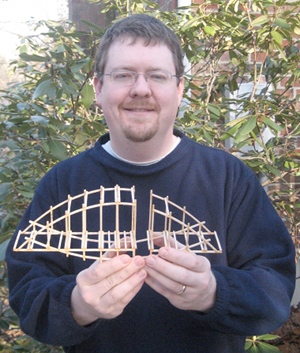
David and his bridge that underwent destructive testing in high school

The owl will nest there and lay eggs, she will hatch them, and care for her young under the shadow of her wings. (Isaiah 34:15)

Periodically our son and grandson come to search the stuff stored in our attic for toys and memories.  This past visit, they found a balsa-wood model bridge that my son had built in high school for a classroom contest.  I had suggested that the catenary shape might be the strongest shape to use for the weight-bearing parts of the bridge.  I left the rest to him.

During the contest, the bridges were subjected to increasing weight until they broke and dropped the weight.  He recalls that his bridge came in second, but in a way, was the best one because his design used the least amount of  balsa wood – it was light weight but very strong.

What is the catenary shape?  It is the shape of the St. Louis Arch and of many ancient and modern arches used in architecture;  the shape is most easily achieved by hanging a chain by its two ends. The natural shape (upside down) it takes between the attachment points is the catenary shape.  It is also very close to the shape of the ends of an egg.

While teaching physics, my students showed how strong this shape is.  In a simple demonstration two students held a bed sheet between them to act as a catching net.  A raw egg (the free-roaming chicken, barnyard eggs are best for this) is thrown hard into the sheet by another student, and, unless the sheet is missed, the egg will not break.  At least I never saw it break from hitting the sheet, assuming the catchers did not let it roll off onto the ground.

The other impressive demonstration requires two straight-sided glass cylinders, such as drinking glasses, where one glass will fit closely inside the other.  The egg (raw)  is padded below and above with a sponge or folded paper towels, for example, and placed in the larger glass.

Important!  The egg is placed so the long axis of the egg is parallel to the sides of the glass; in other words, the egg is placed “on end” in the glass. The bottom of the inner glass is then slid into the outer glass until it is resting on top of the padded egg.

Using a chair to steady the person, and standing on a stool about the same height as the nested glasses, he or she gradually places all of his or her weight on the upper glass showing that the egg will support the weight without crushing.  Of course, there is a limit of how much it will support.  When I last did it, I probably weighed about 200 lbs, and did not break the egg.

Isn’t it amazing, that the law of gravity, as established by the creator, is what causes a chain to hang as it does, that this same shape is that of the eggs laid by various birds and reptiles, and that it forms the strongest type of free-standing arch?  Isaiah 34:15 says, “The owl will nest there and lay eggs, she will hatch them, and care for her young under the shadow of her wings.” God loves us and also invites us to abide in His strong shelter.

Posted by: T. Boyd | February 10, 2010

The Strange Catapult Force

“It is the glory of God to conceal a matter;  to search out a matter is the glory of kings” (Proverbs 25:2)

In the early days of science,  it was believed that there was no connection between electricity and magnetism.  The magnetic force was found in rocks with iron ore in them, and then magnets were made by rubbing these special rocks against iron or steel.  These were then used to make magnetic compasses, giving a wonderful advancement in navigation.

The early experiments with electricity included the investigation of lightning, made most famous with Benjamin Franklin’s dangerous flying of a kite during a thunderstorm (he and his assistant could have been easily killed by a direct hit).   It was also discovered that heat and light could be produced by passing the current from a battery through a thin wire.

However, to show there was no connection between electricity and magnetism, a magnetic compass was placed beneath a wire through which electric current was passed. The equipment was arranged so that the wire was at right angles to the compass needle, thinking that surely if there were a force between them, the needle would be deflected to become parallel to the wire.  But there was no deflection.

However, in 1820, Hans Oersted at the University of Copenhagen while preparing this demonstration, discovered that if the compass needle and the wire are parallel to start with, that the needle would swing to being perpendicular to the wire – just the opposite of that which had been predicted.  It was a serendipitous moment.  He had shown a connection between electricity and magnetism.

This led to the building of an electric catapult, hence the nickname given this force, which today is called the Lorentz Force, named after Hendrik Lorentz who formulated the mathematical equation in 1892 that describes it.

To picture the catapult, imagine a child’s swing scaled down to fit on top of a table.  You would use thin wires instead of chains to hold up the “seat” which is also made of wire. Everything would be connected to a battery so that electric current will flow down one “chain”, through the “seat”, and back up the other “chain.”

Directly below the “seat” you would hold a bar magnet with the north pole pointing upward. When the current was turned on through the “swing,”  the “seat” would be “catapulted” forward or backward, depending on the direction of the current.

You may have seen toys that swing back and forth tirelessly, run by a single AA battery that is based on this principle.  In fact the electrically powered baby swings operate by this catapult force. More importantly this Lorentz Force is what powers electric motors which have played such a large role in the twentieth and twenty-first centuries.

Proverbs says, “It is the glory of God to conceal a matter;  to search out a matter is the glory of kings” (Proverbs 25:2)  It is such a blessing that He also puts in our hearts and minds the desire to discover these hidden laws of His creation.

Posted by: T. Boyd | January 26, 2010

Blue Skies and Red Sunsets

Like the appearance of a rainbow in the clouds on a rainy day, so was the radiance around him. This was the appearance of the likeness of the glory of the Lord. (Ezekiel 1:28)


On our trip to the YMCA today, I asked my grandson why the sky is blue. He said, “Maybe it’s because of the water in the atmosphere.” I replied, “Well that could be part of the reason, but then why is the sky red around the sun at sunset?” He puzzled over that. After a little pause, I gave an explanation and his questions about it helped me clarify the description.

Light, as we described in some articles last year, is made up of small energy bundles called photons. There are red, green, blue photons, and all the other pure colors as well. And sunlight has a mixture of all these colored photons, giving an average to our eyes of white light, or at least it is white in outer space. But our atmosphere affects it in interesting ways.

As the collection of photons of white light passes through the air, the blue photons have about 10 times more chance of being scattered (bouncing off air molecules) than do the red photons. (Today in my research for writing this I found out that Einstein explained this scattering phenomena in 1911 – his contribution to science is amazing, isn’t it?)

Thus the red photons are more likely to pass through the air unimpeded while more of the blue ones bounce off in all directions. Thus when looking at the sky away from the sun, a person will see a mixture of light with more blue photons than red ones, and hence it looks blue – sometimes very blue depending on the sun’s position and the clearness of the air.

On the other hand, as people enjoy a sunrise or sunset, they are looking at the light passing through much more air than when the sun is overhead, so the effect of the blue photons being scattered out is greater, and hence, the direct light from the sun to their eyes or reflecting off the clouds looks red to them.

Why does the moon look larger on the horizon? In fact, it is not larger but is the so-called moon illusion. In fact the width of the moon is exactly the same as it is when it is overhead. On the other hand, the height of the moon on the horizon is actually a little reduced than when overhead, caused by the distortion of the light rays passing through the thicker atmosphere.

There are various theories for the cause of this illusion. The one I like best is that when the moon is near the horizon, our visual system is comparing it to the surrounding scenery, and knowing it is much further away, it seems larger. One article says to “trick your mind out of the moon illusion is to bend over at the waist and look at the moon upside down through your legs” (http://www.howstuffworks.com/question941.htm).

« Newer Posts - Older Posts »

Categories