Posted by: T. Boyd | February 23, 2009

I will give you the treasures of darkness… (Comet Lulin)

” I will give you the treasures of darknesslulin-sketch
and the hoards in secret places,
that you may know that it is I, the Lord,
the God of Israel, who call you by your name.”
(Is. 45:3 ESV)

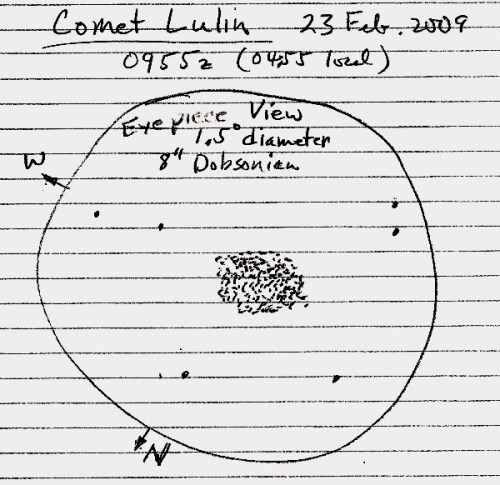
Monday morning I sketched what I saw of Comet Lulin, supposedly a bright comet visible right now.  But believe me, it is not very bright in the area where I live (near Bowling Green, VA).  (Let’s talk sometime about light pollution and what we could do to slow it down or even reverse it)

This is the 3rd or 4th time I have seen the comet through binoculars and telescopes.  Here is a log of my struggles this morning.

4:01 a.m. – Glanced at clock, moaned and got up anyway … bathroom thermometer says it is 27.5 deg. outside.  Hmm… maybe it will be cloudy… nope crystal clear … oh, well, better get out there.

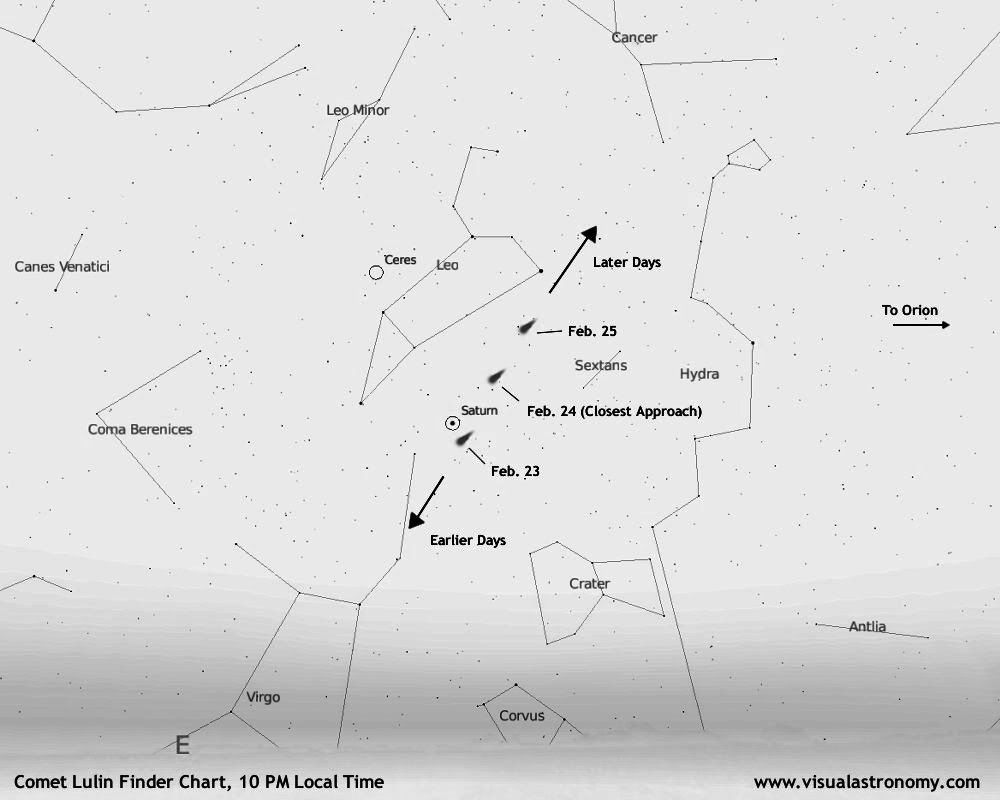
4:25 – Glad I set up telescope last night, but Saturn is behind the trees, and the comet is supposed to be close to it ,,, so I struggle to move telescope to a better spot … OH WOW! … suddenly I am awake when I see a beautiful bright streak of a meteor whiz by … right by Saturn.  Thank you, Lord, for that encouragement.  And there is Saturn in the telescope view … what a beautiful jewel it is, so bright against the dark background, even with the rings almost invisible … they will be on edge for several more months.

4:55 – Using my red l.e.d. headlamp, and a printed copy of the chart of Lulin’s path, I finally catch the comet in the eyepiece … I’ve got to improve my methods.  At 68 years old, getting down on the ground 4 or 5 times to aim the telescope, having it totter as it almost slips off from my too-small platform … it’s too much for this old guy.  But the weariness fades as the Comet comes in focus, and I am young again.

5:30 –  I wander out onto the street knowing it would be a better viewing spot next time, away from my 60 feet tall pine trees, 28 in number.  Yes, it is, and I can see so much of the sky here … but suddenly I am embarrassed as the paper deliverer drives by … he or she probably wonders why this guy is out along the road, hiding his eyes from the headlights, with a blue ski mask over his head … Maybe some morning I will stop him or her and explain what I am doing … and also tell the neighbor who just drove by.

6:00 – Time to go inside and ruin my night vision by turning on the computer screen and start this article … actually that can wait – but slipping between the sheets, I remember that tomorrow morning Lulin and Saturn will be really close together, an event too exciting to miss.   Surely my wife will want to see that too –  or maybe it will be cloudy.

Some good links for Comet Lulin:

Comet Lulin at Visual Astronomy.

A good chart for the next 2 days.

Sky and Telescope on Comet Lulin with complete charts.

Note: This article written by me is copyrighted 2009 by Caroline Progress, used by permission.
Posted by: T. Boyd | February 21, 2009

Help Classify Galaxies

Galaxy Zoo This is neat – found on Visual Astronomy – it uses volunteers to classify a large database of newly-found galaxies.

The history line says “The original Galaxy Zoo was launched in July 2007, with a data set made up of a million galaxies imaged with the robotic telescope of the Sloan Digital Sky Survey. With so many galaxies, the team thought that it might take at least two years for visitors to the site to work through them all. Within 24 hours of launch, the site was receiving 70,000 classifications an hour, and more than 50 million classifications were received by the project during its first year, from almost 150,000 people.”

I just joined and hope to spend some time contributing. Anyone can do it. A tutorial is included. And your classification is checked against other observers to help prevent mistakes.

Posted by: T. Boyd | February 17, 2009

Comet Lulin and Saturn – 17 Feb 2009

Central Virginia, about 28 deg. F., clear skies, waning crescent Moon.

Comet Lulin

At 0900z (0430 EST) 17 Feb. 2009, found Comet Lulin near Spica in Virgo.  The moon, in its last quarter, is still interfering, but should be better in 2-3 days,  The chart in Sky and Telescope is accurate as far as I can tell.  I thought I was seeing the comet with naked eye, and thought it was higher than the chart shows, but I think I was seeing Theta Virginis instead.

I was able to find it with 10×50 binoculars – easily seen.  Brighter, of course, in the 8″ Dobsonian at 36x power.  I didn’t notice the tail and antitail – I doubt I will see those, but will try next time.

Saturn

A little shocking seeing a straight line for the rings, but still beautiful.  Also could see two tiny moons in a line with the rings to the East of the planet.  Very nice.

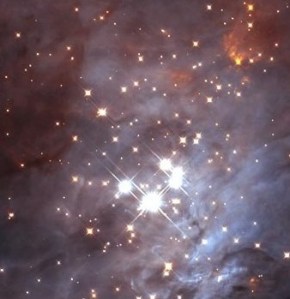
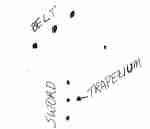
The photograph, courtesy of NASA (Hubble telescope), trapeziumis a scene I saw last week as I re-visited the constellation Orion.  This is the middle “star” of the sword, which when looked at closely (in my telescope) is a tiny, brilliant jewel made up of 4 stars.  It is labeled as the Trapezium.  And it is surrounded by a ghostly cloud of stellar dust.  It is another breathtaking sight in the heavens.  Here is a sketch of Orion’s belt and sword.orion_drawing2
I am currently reading “The Case for a Creator” by Lee Strobel.  I am reminded through that writing that the earth is a very unique place to live.  It is one of the rare places with a life-sustaining atmosphere that is also transparent which allows us to study the wonders beyond our world, as related in this story.

My wife, puzzled by a clue in the crossword, inquired, “3 across – Discovered the structure of the atom – 4 letters starts with B”.  I answered, “Bohr”.

And then not losing an opportunity to spout some knowledge, I asked, “Did you know that Bohr got the idea of how the electrons are trapped in certain strict orbits around the nucleus from sunlight?”

She answered, “No. Tell me more…”  (I  might be exaggerating her enthusiasm).

I went on to explain that sunlight was the main source of discovering that atoms give off certain pure colors when excited by heat or electricity, and this led to the fields of atomic physics and modern chemistry in the early 1900’s.  And the particular combination of gases around each star gives each star a unique “signature” of colors, or as I like to think, a unique song in the symphonic chorus of the heavens declaring the glory of God.

Note: This article copyrighted 2009 by Caroline Progress, used by permission.


Posted by: T. Boyd | February 14, 2009

Venus is changing! And Orion’s fantastic sword

Venus

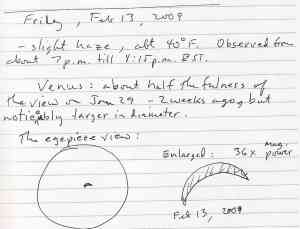
Because Venus and Mercury are “inner” planets, meaning they are closer to the Sun than we are, they both show “phases” like our Moon.  When Venus first appears as an evening “star” it is almost “full moon” shaped.  And then as it gets higher in the sky during the following weeks, it gets slimmer and slimmer in a crecent shape, but it gets brighter and larger in diameter as it draws closer to the earth in its orbit.  Compare the sketch made two weeks ago: Jan.29 sketch, with tonights sketch:venus_13feb2009

The other surprise about Venus, which I have demonstrated twice in my observing career, is you can see it in bright daylight if you look directly at it.  The only way I have been able to do this is when Venus is a morning “star”.  I set up a telescope before dawn, centered on Venus while it was easily seen, and then tracked it during the morning until noon time.  And it was very easy to see through the telescope.  But it also could be seen by the unaided eye by sighting along the barrel of the telescope to find it.

Orion’s Sword

Tonight I returned to visit Orion’s sword after an absence of several years.  Wow!  What a sight.  This is where the 8″ diameter Dobsonian scope showed its stuff.  (I compared it with the 4.5″ diameter Newtonian which was good, but not quite as impressive).  The center of the sword contains a rich view of a nebula and many tiny, close-together bright stars.  The most interesting star group with my scope is a tiny jewel called the Trapezium – four stars that form a trapezoid-shaped pattern.  Here is a photo on another site.  My view was similar to that photo without the color – all I can see with the 8″ scope is a faint white cloud.

The book of Job mentions both Orion and the Pleiades, which I will describe maybe next time.

Job 38:31“Can you bind the chains of the Pleiades
or loose the cords of Orion?

May the creator of the universe, who is also a personal friend, bless you all this weekend.

Boyd

Posted by: T. Boyd | February 9, 2009

Saturn On Edge II

(article submitted to the Caroline Progess, used by permission)
Behold the height of the stars, how high they are! (Job 22:12)
saturn-in-08-and-09new0
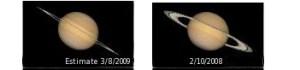
The photographs, used by permission of Wikipedia.com,  show the surprising view of Saturn now compared to just a year ago.  The rings become almost invisible  for several weeks.  This phenomena happens every 14 to 15 years when the plane of Saturn’s rings crosses the plane of the earth’s orbit around the sun.  My wife and I last saw this 29 years ago as the story below tells.

My wife writes:

My husband walked up to me and asked, “What happens every twenty-nine years?”  Although he had given the question no introduction,  I promptly answered, “Saturn makes a complete circuit of the sun.”

“It’s amazing that you would remember that,” he replied.

Actually, it’s far from amazing.  There is something about being urged out of  a warm bed at 2 A.M. when it’s 19 degrees outside that leaves an indelible imprint on one’s brain.  We had been married about a week.  From my perspective, things had been going rather smoothly.  We had previously recognized that we had differing tastes in music, but eventually, I reasoned, he will understand that I really do prefer the Beach Boys to Bach.

I knew, of course, that he had taught astronomy and had a small telescope.  What I didn’t realize until that cold January night was the extent of his enthusiasm for the subject.  He woke me with such delight, insisting that I must accompany him to the balcony to view Saturn turned on its side so that the rings were virtually invisible.  I looked at the clock and at his face.  He clearly saw neither hour nor the frigid cold as deterrents.   I went to the balcony and froze for ten minutes before beginning to plead that seeing Saturn once without its rings must be enough and arguing that all these heavenly bodies must also still be there in May and June when there was no danger of frostbite.  Don’t ever use that argument with an astronomer.  It leads to a long, enthusiastic (on his part) discourse about periods of peak visibility.

Ultimately,  reality set in.  He really loved this stuff.  I began to see these middle-of-the-night invitations as normal – and when he taught astronomy at Randolph Macon, I even thought it was normal that we should have placed our sleeping children in sleeping bags in the car to drive to the observatory to view the Grand Conjunction – the one that was supposed to cause California to fall into the sea.  He held each child up to the telescope, and they went to school that day with pictures of the conjunction taken through the telescope.

And through it all we have learned.  He got me a Beach Boys CD, and I have come to treasure his devotion to God’s handiwork in the heavens and even more to treasure the presence of God in our lives.

Posted by: T. Boyd | February 4, 2009

Venus, the Moon, and Bluebirds in January

venus-and-moon-29-jan2009-iv(This article copyrighted 2009 by Caroline Progress and Lakeway Publishers, Inc., written by myself and used by permission)
“The heavens declare the glory of God,
and the sky above proclaims his handiwork.”
(Ps 19:1 ESV)

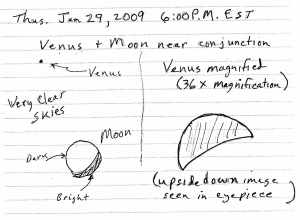
Sketch of Venus and Moon – 29 Jan 2009

We are having another conjunction of Venus and the moon this evening.  They will be very close together somewhere else in the world later tonight – probably in Japan.   I went out to observe the sky – it was breathtaking, the evening western sky.  I never tire of seeing it.

I started a sketch book of what I see, with the first drawing shown.  The left side of the sketch shows Venus and the moon as they appeared to my unaided eye.  On the right side is a sketch of Venus made as I looked through the eyepiece of my 4.5 inch reflector.  You can see that it is less than 1/2 full at its present phase.  It will get “thinner” the next few weeks, but will get brighter as it draws closer to us in its orbit.

Bluebirds the next morning.
At the end of a morning walk with my bride, I strolled to the back yard where the snow had melted in all the sunny areas of the yard.  Here it is, January 30, and already the robins are actively finding food in the grass.  I counted at least a dozen.

And then I noticed a small bird that looked to me like a Junco (snow bird) sitting on the top of the tall swing set pole.  He next flew down to a near-by young tulip tree about 15 feet away and looked at me, turning his body as he did so.  Ah ha!  Look at that flash of blue – it is an Eastern Bluebird!

Not only that, he was gradually joined by 4 other Bluebirds that were females, I believe, since their coloring was more subtle.  And they were hopping around on the bare branches.   One swooped down to the ground when she spotted an early spring bug emerging, I assume.

I started talking with them, asking why they had stayed around this winter.  They cocked theirs heads and replied, I felt certain, that they had grown up in the bluebird box in our yard,  and they just wanted to be near home.

They seemed very friendly and stayed for about five minutes, at least it seemed that long.  Then they said, “See ya later.” and flew off over our rooftop.

I stood there a few more moments reflecting on how wonderful God’s creatures are, and how he created such a wide variety of beautiful animals, of stars, planets, galaxies for our enjoyment and to display His glory in the splendor around us.

Write me at HeWillRejoice@yahoo.com

Boyd

Posted by: T. Boyd | January 29, 2009

Saturn on Edge

The only bright planets visible presently are Venus and Saturn.  The rest are hidden by the Sun.  Venus is convenient – the bright evening “star” which will be close to the Moon on Jan. 29 and 30.  I will try to catch that this evening.  And Saturn is also convenient for early risers, being fairly high in the Southern Sky in the constellation Leo.

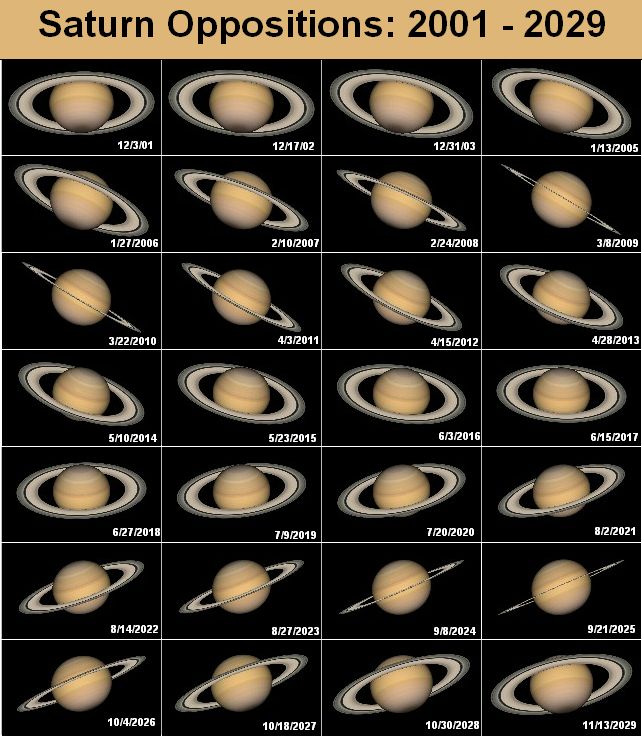
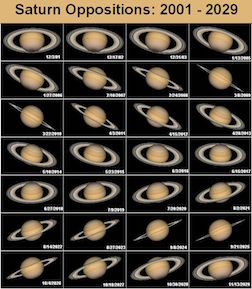
The interesting thing about Saturn is that the rings are “on edge” – barely visible to Earth observers.  This happens twice during its 29 year travel around the Sun.  Every 15 years or so, the plane of the rings crosses the Earth to give this effect.

It’s funny – I missed it last time this happened in 1994 or 1995 – I was too busy teaching science at Caroline High!  Isn’t that ironic?  But in 1980 I saw it according to my wife.  We had just gotten married on Jan 12 of that year and she remembers me dragging her out onto the deck at 3 A.M. to see “Saturn on Edge.”  It was the first week of our marriage and it made her wonder, I am sure, what she had gotten herself into.

Well, I will try seeing it tonight again.  I wonder if she will be romantic enough to join me?  I’ll let you know.

There is an excellent picture of how it will look for the next 30 years on Wikipedia at Saturn’s rings, 2001-2029.  Here is a reduced version:

Saturnoppositions
 
And here is a photo of how Saturn changed from March 2008 to January 2009:

Saturn in Spring 2008 and 10 months later

Saturn in Spring 2008 and 10 months later

Posted by: T. Boyd | January 27, 2009

Monday’s (Jan. 26) Solar Eclipse

annulareclipse
Annular Eclipse photo from Wikipedia

A solar eclipse occured on Monday, visible from the Indian Ocean, so most of us missed it.  But someone was there and took excellent pictures (see link below).  This was an annular eclipse, which means that the moon was not large enough to cover the sun, but, instead, left a ring of fire around the shadow of the moon at “totallity”.

My wife asked, “Why aren’t all eclipses like that?”  And I explained that because the moon-earth distance varies quite a bit, it appears larger at some parts of the year than at other times.  The astonomers use the term eccentricity for describing this.  The moon’s orbit about the earth is not in a circle, but an ellipse.  When the eccentricity of an ellipse is zero, then the ellipse is equal to a circle.  But when it is greater or less than zero, it becomes egg shaped.

The eccentricity of the moon’s orbit is only .054, so the “egg shaped” orbit looks the same as a circle to the eye.  But the tiny  non-circular part causes a slight variation in the size of the moon as seen from the earth – enough to cause the different type solar eclipses.

To be exact, the eccentricity of the earth’s orbit about the sun ( eccentricity = .0167 ), a smaller effect, also affects the eclipses, but to a smaller amount.

You can see the photos at Pictures of Eclipse from Indonesia and read more about annular eclipses at this Wikipedia link.

Boyd

Posted by: T. Boyd | January 25, 2009

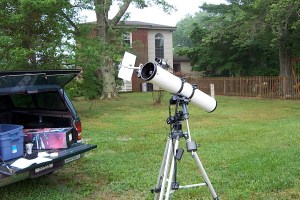
My 4.5 inch Newtonian telescope

About 20 years ago I found this 4.5 inch Newtonian telescope at Costco at a resonable price ($200 range).  I mainly wanted to try out the “go-to” feature that is on so many telescopes now.  It has a hand held computer/remote control that helps you locate some thousand objects in the night sky.

The telescope mount has two drive motors which will swing the telescope to the selected star, planet, or nebula, at least it will after you go through the rather tedious procedure for aligning the mount to two or three known stars. And then the object will be tracked automatically as it offsets the motion caused by the earth’s rotation.

The optics of this telescope seem good, except the eye-piece focuser is of poor quality.  The tripod is fairly heavy duty, and the telecope and mount hold the view steady, unlike a lot of telescopes in the $100 or less range which are usually plagued by vibration.

Here is a photo of the telescope.

Setting up to see transit of Venus across the Sun

Setting up to see transit of Venus across the Sun

« Newer Posts - Older Posts »

Categories